
UKGC Introduces an Illegal Gambling Index: 1% of Britons, 4% of Online Gamblers
The UK Gambling Commission (UKGC) has introduced an Illegal Gambling Index, a new way of measuring how many people in Great Britain engage with unlicensed gambling websites and how that number changes over time. The Index was presented on 10 November 2026 by Rupam Jagota, the Commission's Research and Impact Manager, as the fourth and final phase of its Consumer Voice research series, with the fieldwork carried out by Yonder Consulting. The timing matters: the announcement landed in the same week as the first Illegal Gambling Awareness Week, a coordinated campaign involving regulators in several countries.
At a glance · Reported 10 November 2026
The UKGC Illegal Gambling Index at a glance
- Great Britain
- Gambling Survey for Great Britain
- 7 self-reported indicators
The short answer
The UK Gambling Commission has launched an Illegal Gambling Index that tracks, year on year, how many people in Great Britain engage with unlicensed gambling websites. In its first year of data, 1% of all respondents and 4% of people who gambled online did so in the past 12 months, with higher rates among men and 18 to 24 year olds. It is a measurement tool, not a new rule: the practical step for players is to verify a licence on the regulator's register before depositing.
For anyone who bets or plays online in the UK, the headline is less about a new statistic and more about a new yardstick. Until now, nobody could say with much confidence whether engagement with illegal gambling sites was rising or falling, because there was no consistent measure to compare year with year. The Index is designed to fix that. This article explains what the Index is, what the first numbers say and do not say, what the Commission plans to do with it, and what it means for players who want to stay on the right side of the licensing line.
What the Illegal Gambling Index actually is
According to the Commission's presentation, the Index is a tracking tool: it describes consumer engagement with illegal gambling websites in a way that can be repeated and compared. It brings together seven self-reported behavioural indicators, drawn from survey answers rather than from website traffic or enforcement data. It was built across four phases of work that combined a consumer survey, in-depth interviews, focus groups, and input from expert and advisory groups. The Commission says it is meant to be adaptable, and that it can refine and update the Index as it learns more about how people actually end up on illegal sites.
The source data comes from the Gambling Survey for Great Britain (GSGB), the Commission's large-scale population survey. The Index uses the first year of GSGB data, which gives it a baseline. The Commission describes the early results as some of the first robust estimates of this behaviour, and positions them as a benchmark against which future change can be judged. In other words, the first number is not the story; the trend line that follows it is.
The first numbers: 1% and 4%
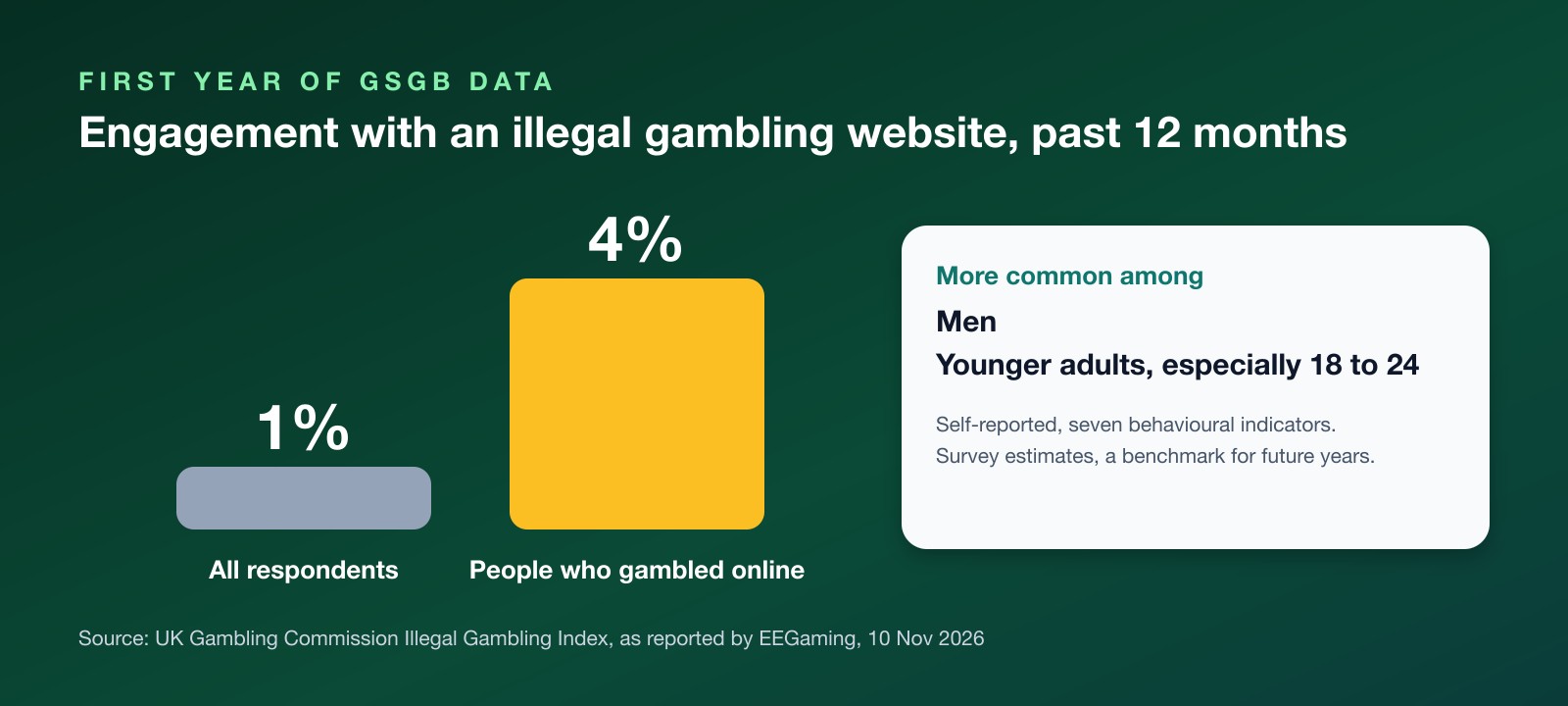
The headline findings from the first year of GSGB data are straightforward:
- 1% of all respondents showed engagement with an illegal gambling website in the past 12 months.
- 4% of people who had gambled online in the previous 12 months showed such engagement.
- Engagement was more common among men and younger adults, particularly those aged 18 to 24.
It is worth reading these figures carefully. The 1% figure is measured against the whole adult population, including the many people who never gamble online, so it is small by construction. The 4% figure uses a far narrower denominator, people who gambled online at all, and is the more useful number for understanding the risk to someone who is actually playing. Neither figure says how much money is involved, how often people use these sites, or whether the people concerned knew the sites were unlicensed. Those are open questions, and the Index is built to start answering them.
Because the measure is self-reported, it also carries the usual survey caveats. People may not realise a site is unlicensed, which could push the real figure higher. People may also be reluctant to admit to it, which pushes in the same direction. The Commission itself frames the numbers as estimates, and that framing is the right one. The sensible way to use them is as a starting point, not a verdict.
Four kinds of consumer
The earlier phases of the Consumer Voice work identified four consumer personas, which the Commission calls Self-Excluders, Skilled Advocates, Social Explorers and Accidental Tourists. The names are the Commission's own, and they point to quite different reasons for ending up on an illegal site.
| Consumer persona | What the research describes |
|---|---|
| Self-Excluders | People who have used UK self-exclusion tools and may be drawn to sites outside that system |
| Skilled Advocates | Confident, experienced gamblers who know what they are doing |
| Social Explorers | People who arrive through friends, communities or online recommendations |
| Accidental Tourists | People who land on illegal sites without realising it |
- Self-Excluders are people who have used the UK's self-exclusion tools and may be drawn to sites outside that system.
- Skilled Advocates are confident, experienced gamblers who know what they are doing and may seek out sites for reasons such as odds, limits or product range.
- Social Explorers tend to arrive through friends, communities or online recommendations.
- Accidental Tourists land on illegal sites without realising it, for example through search results, adverts or social media.
The distinction matters for policy because each group responds to a different intervention. Warnings aimed at people who stumble onto a site by accident are not going to change the behaviour of a confident bettor who is deliberately comparing prices. The Commission says new supplementary questions developed in Phase 3 will be added to the GSGB in 2027, so it can measure how large each of these groups is. That should be the first time the personas move from qualitative description to numbers.
What the Commission says it will do next
The Commission says it will compare the survey findings with web traffic estimates and other intelligence sources. That is a sensible approach: a survey tells you what people say they did, while traffic data tells you what sites are being visited, and the gap between the two is informative. The Index supports the Commission's Illegal Gambling and Crime Evidence Roadmap, which is its plan for building the evidence base on this issue. Phase 4 is described as the final chapter of the Consumer Voice series, which means the next step is applying the framework year after year rather than designing more research.
We want to be precise about what has and has not been announced. The Index is a measurement tool. It is not, on its own, a new enforcement power, a new licence condition or a new rule for operators. Other recent Commission activity has focused on enforcement, and coverage during the same week reported a broader push against illegal operators, but we have not been able to verify those details against the Commission's own releases, so we are not repeating them here. We will update this article if and when they are confirmed.
Why this matters to players on licensed sites
If you only ever bet with UKGC-licensed operators, the Index might look irrelevant. It is not, for two reasons.
First, the licensing line is the thing that protects your money and your rights. A licensed operator has to hold customer funds in line with UKGC rules, offer self-exclusion that works across the licensed market, verify age and identity, and give you access to an approved dispute-resolution route. An unlicensed site has to do none of that, and if something goes wrong there is no UK regulator to complain to. The Index puts a number on how many people are living outside that protection.
Second, the data shapes what comes next. The Commission's evidence on who uses illegal sites, and why, will influence how it designs warnings, how it works with payment providers and platforms, and how it balances player protection with the experience of licensed customers. The more clearly the evidence shows that younger men are the main group at risk, the more likely future messaging and checks are to be aimed at them.
How to check that a site is licensed
The practical takeaway from all of this is simple: check before you play. A few minutes at the start can save a great deal of trouble later.
- Find the licence details in the site footer. A UK-facing operator should name the company that holds the licence and give its licence number.
- Verify it on the regulator's own public register. Do not rely on a badge or a logo on the site itself; search the number on the UKGC register and confirm that the operator name and the web address match.
- Check that the licence is active and covers the activity you want. A licence to offer one kind of gambling does not automatically cover another.
- Look for the safeguards a licensed site must offer. Self-exclusion, deposit limits, reality checks and a clear complaints process are all expected.
- Be cautious about sites reached through adverts, social media or messages. The Accidental Tourist group in the research is a reminder that the route to an illegal site is often not a deliberate search.
We explain the process step by step in our guide on how to check UKGC-licensed betting sites, and you can browse brands that hold the licence on our UKGC-licensed brands ranking. For background on what different licences actually mean, see our beginner's guide to gambling licences and our UK Gambling Commission licensing authority page. Our United Kingdom country page sets out the wider legal picture.
What to watch over the next year
The Index will only become useful once there is a second data point. The key things to watch are whether the 1% and 4% figures move when the next GSGB results are published, whether the gap between younger and older adults narrows or widens, and what the 2027 persona questions reveal about how many people reach illegal sites by accident rather than by choice. If the share of accidental visitors turns out to be large, expect more attention on search, advertising and social platforms. If the share of deliberate users is larger, expect more emphasis on the reasons people choose to leave the licensed market, which is an uncomfortable question for licensed operators as much as for the regulator.
For now, the sensible reading is a cautious one. A small share of the adult population, and a minority of online gamblers, engaged with illegal sites in the first measured year, and the people most at risk are younger men. That is a baseline, not a trend, and it gives players a clear and low-cost step to take: verify the licence before you deposit.
Frequently asked questions
What is the UKGC Illegal Gambling Index?
It is a measure built by the UK Gambling Commission to track how many people in Great Britain engage with illegal gambling websites over time. It combines seven self-reported behavioural indicators from the Gambling Survey for Great Britain.
How many people use illegal gambling sites in Great Britain?
In the first year of data, 1% of all survey respondents showed engagement with an illegal gambling website in the past 12 months, and 4% of people who had gambled online in the previous 12 months did. These are survey estimates and the Commission describes them as a benchmark rather than a final figure.
Who is most likely to use an illegal gambling site?
The research found engagement was more common among men and younger adults, particularly those aged 18 to 24.
Does the Index change any rules for players or operators?
No. It is a measurement tool that supports the Commission's evidence work. It does not, by itself, create new rules or licence conditions.
How can I tell if a betting site is licensed in the UK?
Find the licence number in the site footer, then confirm it on the UK Gambling Commission's public register and check that the operator name and web address match. Our guide linked above walks through the steps.
Sources
- EEGaming: UK Gambling Commission introduces Illegal Gambling Index (10 Nov 2026)
- UK Gambling Commission: news
Cover and infographic designed by AskBigBonus. Background photo: BlueandWhiteStripes, CC BY-SA 4.0, via Wikimedia Commons. Facts checked 11 November 2026; each statement is attributed to the reporting it comes from, and anything we could not verify is flagged in the text.
Written by
Editorial team
AskBigBonus Editorial is the byline for articles prepared by the AskBigBonus editorial team. It is a team byline, not a single person, and we use it for guides and explainers that rely on public documents rather than a named reporter's firsthand experience. How an article is made. We start with the primary source: the regulator's own pages, the official gazette or the tax authority's service page. Where the official text is not public, we use law-firm client alerts and established press and say so in the article. We then compare the facts with the AskBigBonus operator database and note what could not be verified instead of filling the gap. Every article lists its sources and the date we last reviewed it. What we do not claim. We do not say we tested an operator with real deposits or withdrawals unless the article says so and shows the evidence. Articles are general information, not legal, tax or financial advice. Commercial relationships. AskBigBonus may earn a commission from some operators we mention. That does not decide our scores or the order of our rankings; the methodology explains how scores are built. Corrections. If something is out of date or wrong, tell us through the contact page . We correct the article and update its review date.
How we research and scoreWhy AskBigBonusReport a correction
Expertise: Gambling regulation, Licensing and licence checks, Payments and payouts, Bonus terms, Responsible gambling