
UKGC-Licensed Betting Sites 2026: How to Check a Licence in 3 Minutes (and What Changed)
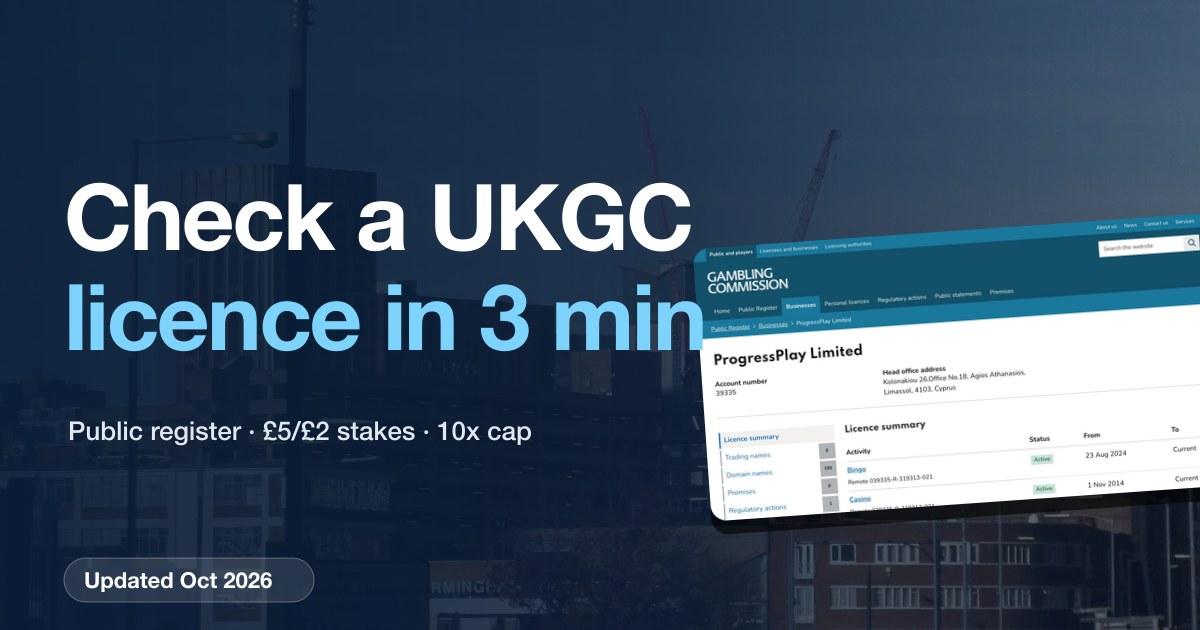
Open any betting site's footer and you will find some version of the same sentence: "licensed and regulated by the UK Gambling Commission", followed by a number. It looks reassuring. The problem is that a sentence in a footer is a claim, and a number is just a number until somebody checks it against the register. The good news is that checking takes about three minutes and you do not need to be an expert.
This guide shows exactly how to do it, using two real licence numbers from the sites in our database as live examples. It then covers the rule changes of the last eighteen months that make a UKGC-licensed site different from the rest of the market, and ends with a short interactive quiz so you can test your instincts.

At a glance · Reviewed 14 October 2026
What a UKGC licence check covers in 2026
- Gambling Act 2005
- Public register
- Remote licence
- GamStop
The short answer
You can check a UKGC licence in about three minutes: find the licence holder and account number in the footer, open that account on the Gambling Commission's public register, confirm the licence is active and the right type, and confirm the exact website is listed. Licensed sites also face £5 (£2 for 18 to 24-year-olds) online slot stake limits, a 10x cap on bonus wagering and a ban on mixed-product bonuses.
What a UKGC licence does (and does not) tell you
The Gambling Commission regulates gambling in Great Britain under the Gambling Act 2005. A remote operating licence means the business has passed the Commission's checks on ownership, finances and suitability, and that it has to follow the Licence Conditions and Codes of Practice, the rulebook known as the LCCP. That rulebook covers things players actually feel: how adverts and bonuses are described, how your money is held, how self-exclusion works and how complaints are handled.
What a licence does not tell you is that a site is the best value, the fastest payer or the friendliest. It is a floor, not a ranking. A licensed brand can still have slow verification, restrictive terms or poor support. The licence tells you there is a regulator to complain to when a site breaks the rules, and that is a significant difference from many other jurisdictions.
The three-minute licence check
- Find the licensee, not just the brand. In the footer, look for a company name and an account or licence number. UK-facing brands are usually operated by a company that holds the licence, and the brand is one of its trading names or domains.
- Open the public register. The Commission publishes a public register. Each licensed business has a page at
gamblingcommission.gov.uk/public-register/business/detail/<account number>, so a footer number can be tested directly. - Check the status and the licence type. You want to see Active, and a remote licence of the right type: casino for slots and table games, general betting standard (real event) for sports betting.
- Check that the website itself is covered. The register lists the domain names and trading names attached to the licence. If you cannot find the exact domain you are on, treat the site as unverified.
If any of those four steps fails, stop. A missing page, a lapsed status or a domain that is not listed is enough reason not to deposit.
A real example: one licence, seven brands
When we pulled the licence numbers for the casinos in our database that state a UKGC licence, a pattern jumped out. Nine casinos cite just two account numbers.
| Account number | Licence holder on the register | Brands in our database |
|---|---|---|
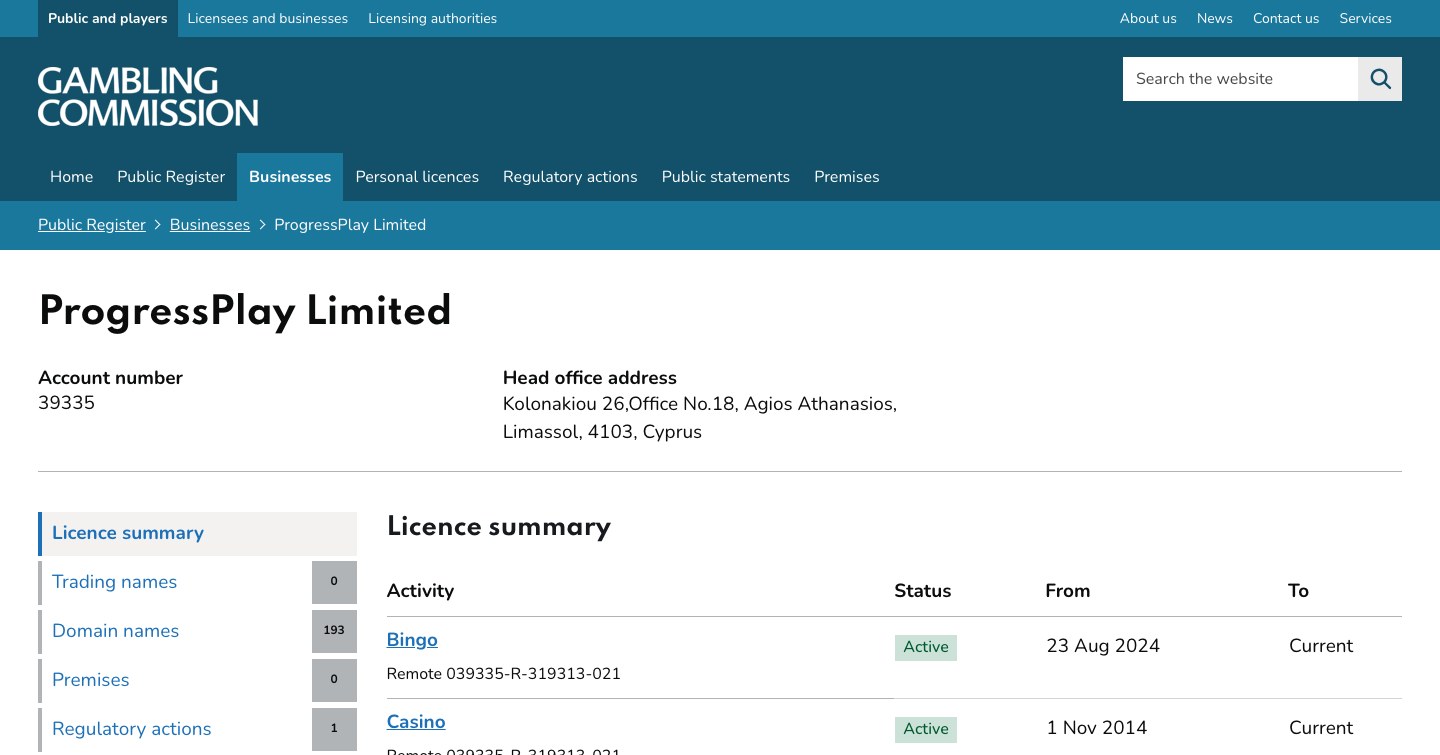
| 39335 | ProgressPlay Limited (Limassol, Cyprus) | Betmaze, Betrino, Bluefox Casino, MogoBet, Monster Casino, Spinzwin, The Online Casino |
| 39326 | Skill On Net Limited (Limassol, Cyprus) | Luna Casino, PlayKasino |
The register shows ProgressPlay's licences as active: remote casino (since 1 November 2014), remote bingo (since 23 August 2024) and remote general betting standard, real event (since 17 December 2018), with 193 domain names recorded against the account. Skill On Net holds remote casino, bingo, gambling software and a virtual-event betting licence, with 53 trading names and 61 domain names on file. Register contents change, so treat these as of the date we read them: 14 October 2026.
The lesson is useful for any player. Many different-looking casino brands are white-label sites run by the same licensee on the same platform. That is perfectly legal, but it means the licence number tells you about the operator behind the brand, and that the terms, payment speeds and support will often look similar across brands that share one back end.
The rules that changed (and why they matter)
Great Britain's online rules tightened considerably between 2025 and 2026. Here are the changes that affect what you see on a licensed site, with their source.
Stake limits on online slots
The Gambling Commission's own guidance sets maximum stakes for online slots per game cycle: £5 for adults aged 25 and over and £2 for 18 to 24-year-olds. The £5 limit took effect on 9 April 2025 and the £2 limit on 21 May 2025, through a new licence condition. The limits apply to slots only, not to roulette, blackjack or other casino games. The same guidance requires a minimum gap of 2.5 seconds between game cycles.
A 10x ceiling on bonus wagering
From 19 January 2026, licensed operators may not require more than ten times the bonus amount to be wagered before bonus winnings can be withdrawn. The date was moved back once, from 19 December 2025, to give the industry time to prepare. The requirement applies to bonus funds, must be shown clearly in a promotion's significant conditions, and covers offers to new and existing customers alike. Law-firm briefings describe the change as a rewording of Social Responsibility Code 5.1.1.
No more mixed-product bonuses
The same package bans promotions that combine more than one product type, such as betting, casino, bingo and lottery, in a single offer. The old "bet on football to unlock casino spins" model is gone from licensed brands.
If you want to understand how a wagering requirement is calculated in practice, our guide to understanding wagering requirements walks through it with numbers.
Self-exclusion and complaints
UKGC licence conditions require remote operators to take part in GamStop, the national online self-exclusion scheme. Register once and every participating licensed site is blocked for the period you choose. It does not cover unlicensed sites, which is one more reason the licence check above matters.
If something goes wrong, you complain to the operator first. If you are not satisfied, a licensed operator must be able to point you to an approved alternative dispute resolution provider. The Commission itself says it does not resolve individual disputes, so the ADR route is the one that can change the outcome for you. Support is available from GambleAware if gambling is causing you problems.
Five red flags that justify walking away
- A licence number with no company name. The register is searchable by account number, so a number alone is easy to check and easy to fake.
- "UKGC licensed" but the domain is not on the register. This is the single most common trick. The brand may be real, the domain a copy.
- Wagering above 10x on a UK-facing offer. Since 19 January 2026 this should not exist on a licensed site for UK customers.
- Slot stakes above the limits. If a UK-facing slot lets you stake more than £5, or £2 if you are under 25, the site is not applying GB rules.
- No visible GamStop or responsible-gambling tools. Licensed sites show these prominently.
Where to find UKGC-licensed brands on AskBigBonus
Our UKGC-licensed brands ranking lists the operators in our database that carry a UKGC licence, ordered by Trust Index. The United Kingdom country page adds the regulatory background, and a beginner's guide to gambling licences explains how other regulators compare. As always, a listing on our site is information, not a guarantee. Check the register yourself before you deposit.
Test yourself: the red-flag quiz
The quiz below this article gives you six realistic footers and offers and asks you to decide whether to deposit. It takes under two minutes, runs in your browser and stores nothing.
FAQ
How do I check if a betting site has a UKGC licence?
Find the company name and account number in the site footer, open that account's page on the Gambling Commission public register, and confirm the licence is active, is the right type, and that the site's exact domain is listed.
What is the maximum stake on UK online slots?
£5 per game cycle for adults aged 25 and over, and £2 for 18 to 24-year-olds. The limits came into force on 9 April and 21 May 2025 and apply to online slots only.
Is there a cap on wagering requirements in the UK?
Yes. Since 19 January 2026 licensed operators cannot require more than 10 times the bonus to be wagered before bonus winnings can be withdrawn.
Do UKGC-licensed sites have to offer GamStop?
Remote licensees are required to participate in GamStop, the national online self-exclusion scheme, so registering once blocks all participating licensed sites.
Can I be sure a brand is safe because it cites a UKGC number?
No. The number must belong to a licence that is active, covers the right activity and lists the exact website. Even then a licence is a minimum standard rather than a quality score.
Sources
- Gambling Commission — online slots stake limit guidance
- Gambling Commission public register — account 39335
- Gambling Commission public register — account 39326
- Harris Hagan — update on the new gambling promotion rules
General information for adults aged 18 and over, not legal advice. Rules and register entries change; confirm current details with the Gambling Commission. 18+. Gamble responsibly. Reviewed against the sources above on 14 October 2026.
Quiz: spot the licence red flag
Six realistic situations. Pick the safest response. Demo only: nothing is stored.
Question 1/6
A site footer says "Licensed by the UK Gambling Commission" but shows no company name or number. What do you do?
Written by
Editorial team
AskBigBonus Editorial is the byline for articles prepared by the AskBigBonus editorial team. It is a team byline, not a single person, and we use it for guides and explainers that rely on public documents rather than a named reporter's firsthand experience. How an article is made. We start with the primary source: the regulator's own pages, the official gazette or the tax authority's service page. Where the official text is not public, we use law-firm client alerts and established press and say so in the article. We then compare the facts with the AskBigBonus operator database and note what could not be verified instead of filling the gap. Every article lists its sources and the date we last reviewed it. What we do not claim. We do not say we tested an operator with real deposits or withdrawals unless the article says so and shows the evidence. Articles are general information, not legal, tax or financial advice. Commercial relationships. AskBigBonus may earn a commission from some operators we mention. That does not decide our scores or the order of our rankings; the methodology explains how scores are built. Corrections. If something is out of date or wrong, tell us through the contact page . We correct the article and update its review date.
How we research and scoreWhy AskBigBonusReport a correction
Expertise: Gambling regulation, Licensing and licence checks, Payments and payouts, Bonus terms, Responsible gambling