
Illegal Gambling Awareness Week: How to Check a Betting Site Is Licensed Before You Deposit
Regulators from several countries are using this week, 9 to 13 November 2026, to tell players the same thing: check that a gambling site is licensed before you hand over any money. The first Illegal Gambling Awareness Week is a coordinated campaign run through the International Association of Gaming Regulators (IAGR), backed by authorities including Ontario's Alcohol and Gaming Commission (AGCO) and the Illinois Gaming Board. It comes with a new verification website, checkbeforeyouplay.org, which is meant to help consumers tell licensed operators from unlicensed ones.
At a glance · 9 to 13 November 2026
Illegal Gambling Awareness Week at a glance
- IAGR campaign
- Ontario AGCO
- Illinois Gaming Board
- checkbeforeyouplay.org
The short answer
Regulators in several countries are using the first Illegal Gambling Awareness Week to give players one message: check that a site is licensed before you deposit. Find the licence number in the site footer, confirm it on the regulator's own public register, make sure the licence covers where you live, and test with a small deposit and withdrawal first. A licence only protects you if it applies to your market.
The campaign arrives alongside a separate piece of UK research, covered in our report on the UKGC's data-driven oversight and the new Illegal Gambling Index, which found that a small but real share of British adults had engaged with an illegal gambling site in the past year. This article takes the practical angle: what a licence actually does for you, the checks that take less than five minutes, the warning signs that should make you stop, and what to do if you have already deposited somewhere you now doubt.
What the awareness week is, and who is behind it
According to the announcement from the AGCO, the Illegal Gambling Awareness Week is a global campaign led by the IAGR to help consumers identify and avoid unlicensed online gambling sites. It is the first time the association has run it. Other regulators have joined: the Illinois Gaming Board has announced it is taking part, and the reporting we saw says a Florida regulator has too. The common message is that it is much easier to avoid a problem before depositing than to recover money afterwards.
The verification site, checkbeforeyouplay.org, is the practical piece. The idea is that a player can look up whether an operator is authorised in their jurisdiction without having to know where each regulator keeps its register. We have not tested the site's coverage, so we describe it as the campaign's own tool and we would still recommend confirming a licence directly on the relevant regulator's public register, which is the authoritative source.
What a licence actually does for you
It is easy to treat a licence as a logo. It is better understood as a set of obligations on the operator and a route for you to complain if they are not met. Depending on the regulator, a licensed operator can be required to:
- Verify your age and identity before you gamble, so that minors are kept out and accounts are tied to real people.
- Protect your funds according to the regulator's rules on how player money is held and reported.
- Provide safer-gambling tools such as deposit limits, time-outs and self-exclusion, and respect them.
- Publish clear terms for bonuses and withdrawals and handle complaints through an approved process.
- Submit to audits and enforcement, so that a regulator can fine, suspend or revoke a licence if the operator breaks the rules.
The important point is that these protections exist only inside the system. If you deposit with a site that holds no licence in your jurisdiction, there is no regulator to complain to, no approved dispute-resolution route, and no guarantee that your balance can be withdrawn. Licences differ in strength: some regulators are stricter than others, and some licences are issued for use in one market only. That is why the question to ask is not just whether a site has a licence, but whether it has one that applies to where you live. Our beginner's guide to gambling licences explains how the main regimes differ.
A five-minute check before you deposit
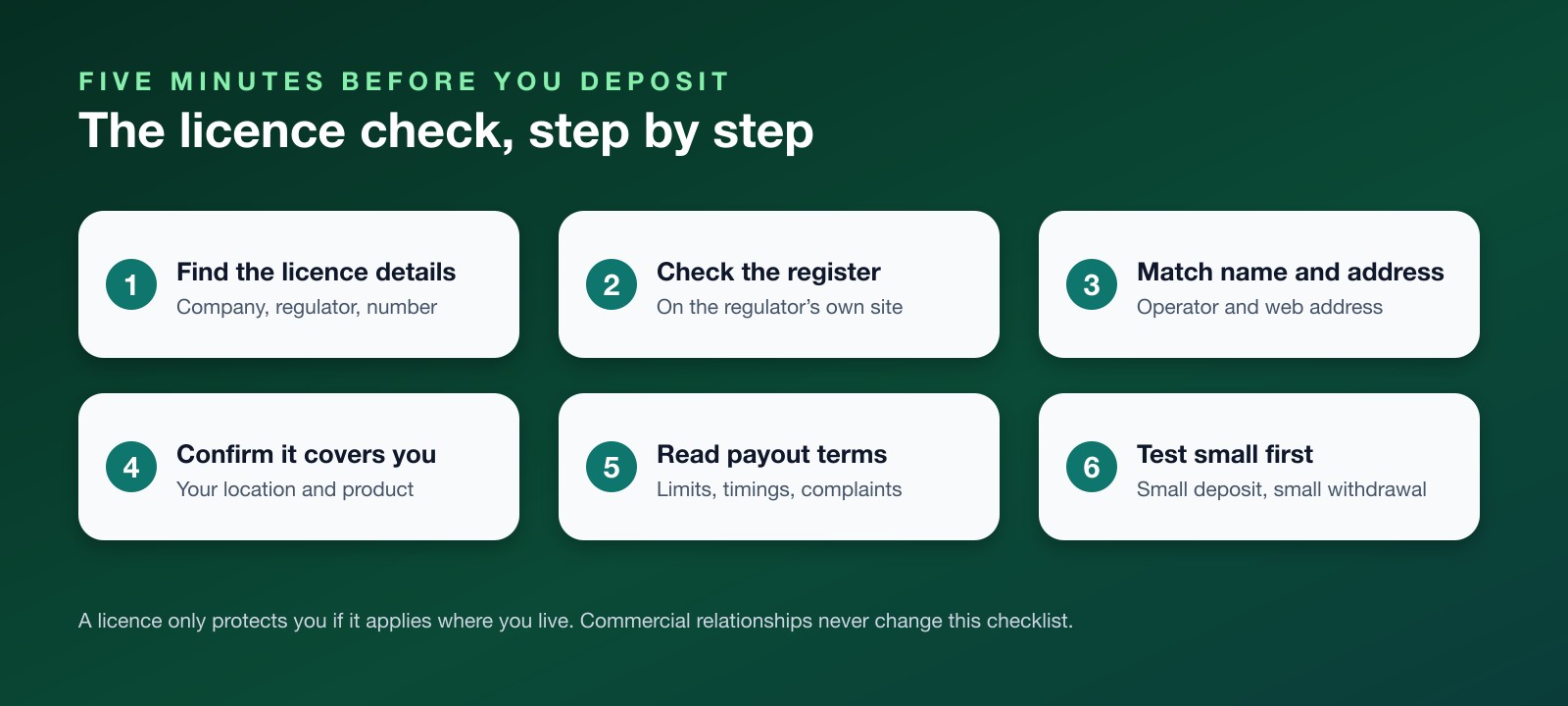
- Find the licence details. A legitimate operator shows the name of the company holding the licence, the regulator and the licence number, normally in the footer or on a licensing page. If you cannot find them, that is already a warning.
- Check the regulator's own register. Search the licence number or company name on the regulator's website, not on a page linked from the gambling site. Confirm the operator name and the web address both match.
- Confirm the licence covers your location. Some licences allow an operator to serve only certain countries. A licence from one regulator does not make a site legal in another country.
- Check the licence is current and the right type. A licence can be suspended, revoked or limited to a certain product, such as sports betting only.
- Read the withdrawal and complaints terms. Look for clear payout times, verification requirements and a named complaints route.
- Test with a small deposit and a small withdrawal first. If you cannot withdraw a small amount without friction, do not deposit more.
If you are in the UK, our guide to checking UKGC-licensed betting sites gives the specific steps, and our UK Gambling Commission licensing authority page explains what the licence involves. Our Curaçao eGaming page and other licence pages cover the other major regimes, and our Trust Score methodology shows how licensing feeds into the way we rate operators.
Warning signs that should make you stop
None of these proves a site is illegal on its own, but several together should make you reconsider.
| Warning sign | Why it matters |
|---|---|
| No licence details, or a number not on the register | The site is outside any regulator's accountability |
| Company name that does not match the register | The licence may belong to someone else |
| Bonuses that look too good to be true | Unclear terms often hide unpayable conditions |
| Pressure to deposit fast or move to a messaging app | A common pattern in scams |
| Endless verification after a win | Withdrawals are where unlicensed sites fail players |
- No licence information, or a licence number that does not appear on the regulator's register.
- A company name on the site that does not match the register, or a licence copied from another operator.
- Bonuses that look too good to be true, especially with unclear wagering terms or no terms at all.
- Pressure to deposit quickly, to use unusual payment routes, or to move the conversation to a messaging app.
- Reaching the site through an advert or message you did not ask for. The UK research describes a group it calls Accidental Tourists, who land on illegal sites without realising it.
- Withdrawal problems, such as endless verification requests or new conditions appearing after you win.
- No safer-gambling tools, or no way to set limits or self-exclude.
Why the problem is bigger than it looks
The new UK data gives a sense of scale. In the first year measured, 1% of all survey respondents showed engagement with an illegal gambling website in the past 12 months, and 4% of people who had gambled online did, with the highest rates among men and younger adults, particularly 18 to 24. Those are small percentages but large numbers of people, and they describe behaviour that only the survey could reveal, since people rarely report it any other way. Other regulators have raised similar concerns about the growth of unlicensed online gambling. A Montreal study reported this week found that online gambling participation in the area has tripled since 2018, and a Quebec industry coalition is asking the provincial government to set out its regulatory plans.
The common thread is that licensed and unlicensed products now sit side by side on the same search results, adverts and social feeds. A player cannot rely on how a site looks. The only dependable test is the regulator's register.
If you have already deposited somewhere you doubt
If you now suspect a site is not licensed, act calmly and quickly.
- Stop depositing. Do not chase a withdrawal by adding money, and do not pay fees to release winnings.
- Try to withdraw what you can, but do not enter personal or banking details beyond what you have already provided.
- Keep records: screenshots of the site, your account balance, transaction receipts and any messages with support.
- Contact your bank or payment provider to ask about options, including whether a transaction can be disputed.
- Report the site to the gambling regulator in your country, and to consumer protection or fraud authorities if you believe you were deceived.
- Use support services if gambling is causing you harm. If you are in the UK, GamStop and the National Gambling Helpline offer free help.
The bottom line
Awareness campaigns can feel generic, but the advice at the centre of this one is specific and effective: look up the licence on the regulator's own register before you deposit. It takes minutes, it costs nothing, and it removes most of the risk that you will lose money to a site with no accountability. We will keep covering the regulatory changes that affect which sites are licensed where, from Brazil's shutdown of its online betting sector to new licensing regimes in Europe, because a licence is only useful if you know what it covers.
Frequently asked questions
What is Illegal Gambling Awareness Week?
A global campaign, running 9 to 13 November 2026 and led by the International Association of Gaming Regulators, to help consumers identify and avoid unlicensed online gambling sites. Regulators including Ontario's AGCO and the Illinois Gaming Board are taking part.
What is checkbeforeyouplay.org?
A verification website launched by the campaign to help people check whether a gambling operator is licensed. Confirm what it tells you against the relevant regulator's own register.
How do I know if a gambling site is licensed?
Find the licence number and regulator in the site's footer, then check the number and company name on that regulator's public register, and confirm the licence covers your location.
Is a licence from any country enough?
No. A licence has to apply to the market you are playing from, and regulators differ in how strict they are. Check what the licence covers, not just that one exists.
What should I do if a site will not pay out?
Stop depositing, keep records, contact your bank or payment provider, and report the site to your country's gambling regulator.
Sources
- AGCO: supporting the IAGR Illegal Gambling Awareness Week
- EEGaming: UKGC Illegal Gambling Index (10 Nov 2026)
Cover and infographic designed by AskBigBonus. Background photo: Blogtrepreneur, CC BY 2.0, via Wikimedia Commons. Facts checked 11 November 2026; each statement is attributed to the reporting it comes from, and anything we could not verify is flagged in the text.
Written by
Editorial team
AskBigBonus Editorial is the byline for articles prepared by the AskBigBonus editorial team. It is a team byline, not a single person, and we use it for guides and explainers that rely on public documents rather than a named reporter's firsthand experience. How an article is made. We start with the primary source: the regulator's own pages, the official gazette or the tax authority's service page. Where the official text is not public, we use law-firm client alerts and established press and say so in the article. We then compare the facts with the AskBigBonus operator database and note what could not be verified instead of filling the gap. Every article lists its sources and the date we last reviewed it. What we do not claim. We do not say we tested an operator with real deposits or withdrawals unless the article says so and shows the evidence. Articles are general information, not legal, tax or financial advice. Commercial relationships. AskBigBonus may earn a commission from some operators we mention. That does not decide our scores or the order of our rankings; the methodology explains how scores are built. Corrections. If something is out of date or wrong, tell us through the contact page . We correct the article and update its review date.
How we research and scoreWhy AskBigBonusReport a correction
Expertise: Gambling regulation, Licensing and licence checks, Payments and payouts, Bonus terms, Responsible gambling