
How We Calculate Trust Score: The 15 Factors Behind Every Operator Rating on AskBigBonus
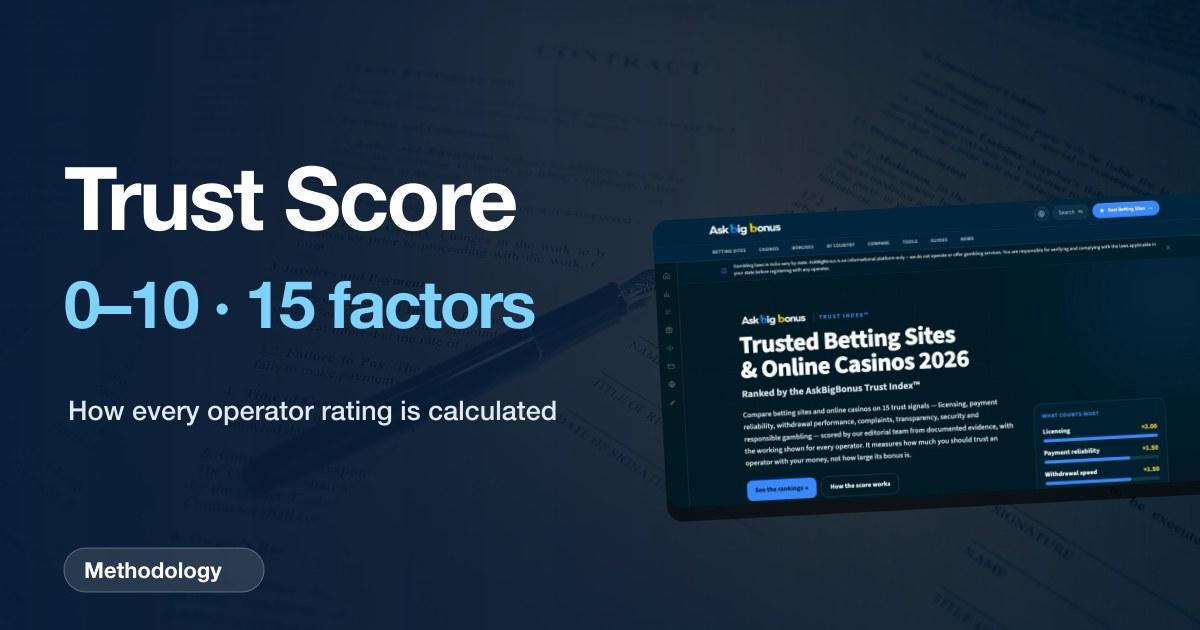
Every operator on AskBigBonus carries a Trust Score, a 0–10 rating that tries to answer one question: how much should you trust this site with your money? People search for "how to tell if a betting site is trustworthy", "online casino trust rating" and "is this bookmaker safe", and a single number is only useful if you know what is inside it.
So here is the method in full: the fifteen scored dimensions, the weights, how the number is calculated, a worked example, what the score does and does not mean and when it changes.
At a glance · Methodology reviewed October 2026
Trust Score at a glance
- 0–10 scale
- 15 dimensions
- Weighted formula
- Not for sale
The short answer
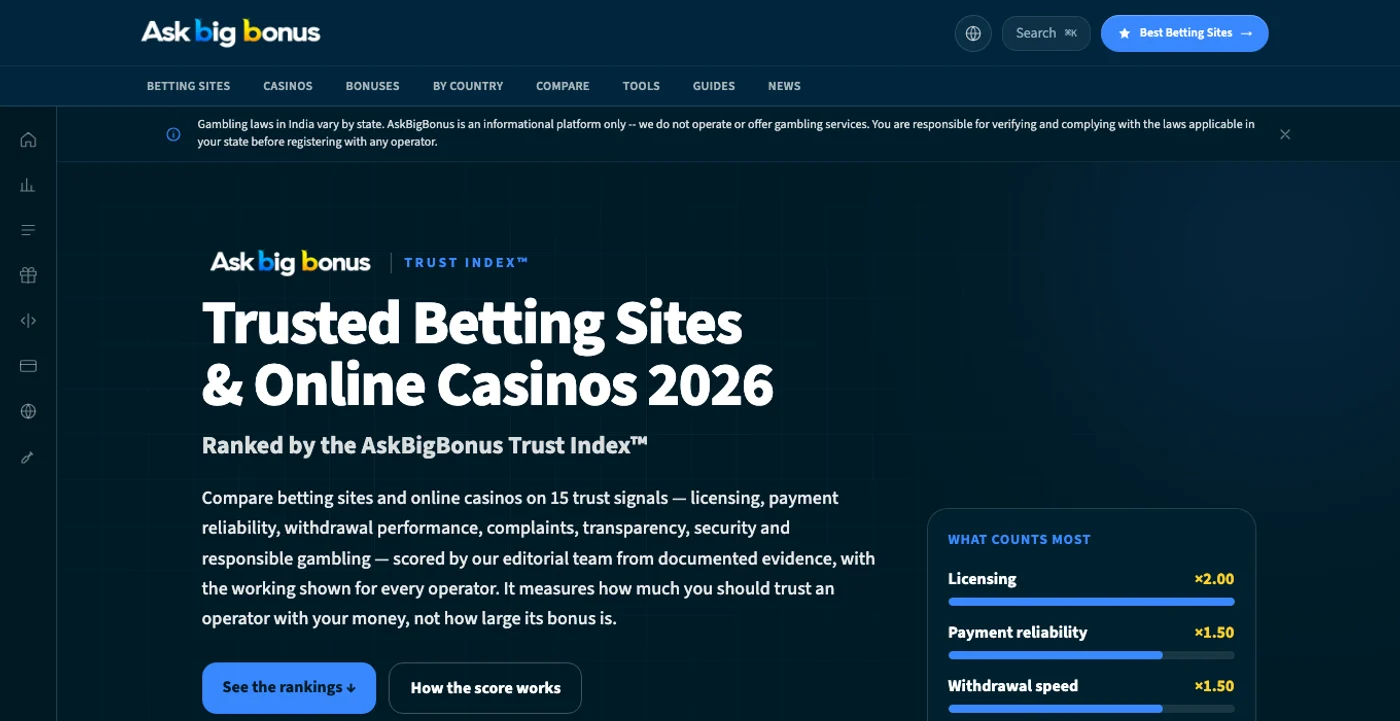
Trust Score is a 0–10 rating built from fifteen weighted dimensions, not an editor's gut feeling. Licence standing carries the heaviest weight (2.0), followed by payment reliability, withdrawal speed and complaint response (1.5 each). Operators cannot pay to improve their score; each dimension is tied to evidence such as a regulator's public register or a verified payout time.
Trust Score is the single number we attach to every operator we list — a 0–10 rating that's meant to answer one question at a glance: how much should you trust this site with your money? It looks simple on the page, but it's built from fifteen separate scored dimensions, not a single editor's gut feeling, and we think it's worth explaining exactly how it works rather than asking you to take it on faith.
What Actually Gets Scored: The 15 Trust Score Dimensions
Every operator we track has an internal record — operator_trust_metrics — with a 0–10 score for each of fifteen dimensions. An analyst updates these as new evidence comes in: a license renewal, a wave of withdrawal complaints, a bonus term that turns out to be misleading. None of them are guesses; each is tied to something we can point to — a regulator's public register, a payout time we've verified, a support ticket we've seen resolved (or not).
The fifteen dimensions aren't weighted equally. We think some things matter more to whether your money is safe than others, so the formula reflects that:
- License standing (weight 2.0) — the single heaviest factor. An active, unrestricted license from a real regulator is the baseline everything else builds on; a suspended or lapsed one drags the whole score down hard, regardless of how good the site otherwise looks.
- Payment reliability, withdrawal speed, complaint response (weight 1.5 each) — the three things that determine whether you actually get paid, and how much friction you go through to get there.
- Transparency, security, responsible gambling tooling (weight 1.0 each) — how clearly the operator states its terms, how it protects your account and funds, and whether it gives you real tools (deposit limits, self-exclusion, reality checks) rather than a token link in the footer.
- Support quality, bonus fairness (weight 0.75 each) — how good the operator is when something goes wrong, and how honest the fine print on its promotions actually is.
- Affiliate reputation, mobile experience, website quality, KYC friction, country availability, crypto support (weight 0.5 each) — smaller factors individually, but they still move the needle, especially for operators that are close to each other on the heavier criteria.
Each Trust Score Dimension in Plain Terms
The list above groups dimensions by weight, but it's worth being specific about what we're actually looking at for each one — these are the same categories you'll see broken out individually on every operator's Trust & Safety panel:
- Licensing — who regulates the operator, and whether that license can actually be verified against the regulator's own public register, not just claimed in a footer badge. A top-tier regulator (UKGC, MGA) scores differently than an overseas one (Curaçao), and a license under active review scores differently than one in good standing.
- Payment reliability — whether deposits and withdrawals actually process the way the operator says they will, across the currencies and methods it lists, including crypto where relevant.
- Withdrawal speed — how long cash-outs genuinely take once they're approved, not the "up to X business days" language in the terms. This is the same figure that powers our Fastest Withdrawal ranking directly — it isn't a separate, softer number used only here.
- Complaint response — how the operator handles disputes when something goes wrong: whether there's a real path to resolution, and whether it's actually used.
- Transparency — how clearly the operator states its terms, ownership, and policies, rather than burying the details that matter in a wall of fine print.
- Security — encryption, account protections, and how the operator has handled security incidents if any are on record.
- Responsible gambling tooling — deposit limits, self-exclusion, session reality checks, and whether they're easy to find and actually use, not a single link at the bottom of the page.
- Support quality — how good the operator is when you actually need help: response time, whether the issue gets solved, and whether live chat is real or decorative.
- Bonus fairness — the honesty of wagering requirements, minimum deposits, and game-weighting rules on its promotions. This is a different, narrower measurement than our Bonus Value score, which scores a specific individual offer rather than the operator's general pattern of behavior.
- Affiliate reputation — how the operator treats the sites and partners that refer players to it, which tends to correlate with how it treats players directly.
- Mobile experience — how well the app or mobile site actually performs. This is the same figure behind our Best Betting Apps ranking.
- Website quality — general usability and platform polish, independent of any single feature.
- KYC ease — how straightforward identity verification is in practice, since a licensed operator is required to run it regardless.
- Geographic availability — how broadly the operator is confirmed available, and how clearly it states where it isn't.
- Crypto support — genuine, confirmed cryptocurrency deposit and withdrawal support, not just a "we accept crypto" badge. This is the same figure behind our Best Crypto Betting Sites ranking.
A score is a starting point. Always check the licence yourself on the regulator's register and read the withdrawal terms before you deposit.
How the Trust Score Is Actually Calculated (Weights and Formula)
Trust Score is a weighted average, not a sum — an operator isn't penalized for a metric we simply haven't recorded yet, only for one that's been recorded and scored poorly. Concretely: we multiply each recorded score by its weight, add those together, and divide by the total weight of everything actually recorded for that operator. If we've only logged five of the fifteen dimensions so far, the score reflects those five — it doesn't silently assume the missing ten are perfect, but it also doesn't punish the operator for data we haven't gathered yet.
That's also why you'll occasionally see a Preliminary tag next to a Trust Score on this site: it means the number is real and calculated the same way as any other, but the operator doesn't have a written editorial verdict yet — we'd rather show you an honest, data-backed preliminary score than hide it until the full review is finished.
A worked example
Say we've only recorded three of the fifteen dimensions for a hypothetical operator so far: licensing at 9.0 (weight 2.0), withdrawal speed at 7.0 (weight 1.5), and support quality at 6.0 (weight 0.75). The calculation is:
(9.0 × 2.0) + (7.0 × 1.5) + (6.0 × 0.75) = 18.0 + 10.5 + 4.5 = 33.0
2.0 + 1.5 + 0.75 = 4.25
33.0 ÷ 4.25 ≈ 7.76
That 7.76 is a real, honest Trust Score — just a Preliminary one, since twelve dimensions haven't been scored yet. As an analyst logs evidence for the remaining twelve, each one folds into the same formula and the score moves to reflect it, up or down, without ever assuming an unscored dimension is perfect by default.
What a Trust Score Means in Practice
Roughly, here's how to read it:
- 8.5 and above — an active license in good standing, no material unresolved complaints, and bonus terms we'd consider fair and clearly stated.
- 6.5–8.4 — solid on the fundamentals, with one or two softer spots — maybe slower withdrawals than we'd like, or support that's adequate rather than excellent.
- Below 6.5 — usually means we've found something specific worth flagging: a license under review, a pattern of complaints, or bonus terms we think are designed to confuse rather than inform. We'll always say what it is in the operator's editorial verdict, not just show a low number and leave you guessing.
When and Why Trust Scores Change
There's no fixed review schedule. A score updates the moment new evidence changes one of the fifteen underlying metrics — a license gets suspended, a withdrawal complaint gets resolved faster than usual, an operator quietly tightens its bonus terms. That means two operators with the same score today can diverge tomorrow if one has a regulatory action and the other doesn't. We log every change to an operator's public change history, so you can see not just the current number but what moved it.
Trust Score is deliberately not the same thing as "the operator we'd personally recommend" — a site can score well on every dimension we track and still not be the right fit for how you play (unavailable in your country, no crypto support, a game library that doesn't suit you). Treat it as a floor, not a ceiling: a strong score means we haven't found a reason not to trust the operator with your money, not that it's automatically the best choice for you specifically.
Trust Score vs. Our Other Scores
Trust Score isn't the only number we compute, and it's worth knowing where the boundaries are so you're reading the right one for the question you actually have:
- Bonus Value scores one specific offer — its wagering requirement, minimum deposit, and expiry window — not the operator as a whole. An operator with a strong Trust Score can still list a mediocre individual bonus, and vice versa; see our bonus comparison page for how that's calculated.
- Category-specific rankings (crypto, withdrawal speed, mobile apps) sort by a single one of the fifteen dimensions in isolation, rather than the blended weighted average. An operator can rank #1 on withdrawal speed specifically while sitting in the middle of the pack on overall Trust Score.
- The Transparency Index, covered in our 2026 Transparency Report, measures a narrower, different question: not "is this operator trustworthy" but "how much has this operator actually disclosed publicly," scored only on the specific disclosure dimensions we hold real data for.
None of these numbers are designed to replace each other — they answer different questions, and we'd rather give you three honest, narrow answers than blend them into one score that quietly averages away the distinction.
Trust Score FAQ: Common Questions Answered
Can an operator pay to improve its Trust Score?
No. Commercial relationships — including whether we earn a commission when you sign up through our link — play no role in any of the fifteen scored dimensions. An operator with a strong affiliate deal and a suspended license still scores as if its license is suspended, because that's what the data shows.
Does a low Trust Score mean an operator is a scam?
Not necessarily. A low score more often reflects something specific and correctable — an overseas-only license, a documented pattern of withdrawal delays, bonus terms we think are misleading — rather than proof of fraud. We explain the specific reason in the operator's editorial verdict rather than leaving a bare number to imply the worst.
Why do two similar operators sometimes have very different scores?
Usually because one has more of the fifteen dimensions actually recorded, or because the recorded dimensions differ meaningfully — one holds a top-tier license and the other doesn't, or one has a real pattern of complaint resolution on file and the other has none logged either way.
How often is my chosen operator's score reviewed?
There's no calendar-based schedule — see "When scores change" above. Any operator's full change history is visible on its review page, so you can check exactly when and why its score last moved.
Cover image designed by AskBigBonus with a screenshot of the official page, retrieved 16 October 2026. Background photo: Blogtrepreneur, CC BY 2.0, via Wikimedia Commons.
Written by
iGaming Journalist & Editorial Specialist
Jamie Reyes is an iGaming journalist and editorial specialist with eight years of experience covering online betting and casino markets. Jamie focuses on operator licensing, payment systems, regulatory developments, player-facing terms and the factors that determine whether an online gambling platform is genuinely trustworthy. As AskBigBonus's editorial lead covering licensing and payments, Jamie is responsible for how the site researches and presents that information — checking regulatory status, payment availability, withdrawal processes and the terms attached to bonuses, then turning that research into content a player can actually use before signing up. That work feeds directly into how AskBigBonus evaluates operators across the site.
Expertise: Online Betting Sites, Online Casinos, Gambling Licenses, Operator Regulation, Payment Methods, Deposits & Withdrawals, KYC & Verification, Responsible Gambling, Betting Terms & Conditions, Trust & Safety, Sports Betting Markets, iGaming Industry News