
Is Online Betting Legal in Bangladesh? The Gambling Prevention Act 2026 Explained
Bangladesh stopped treating online betting as a legal grey area on 1 July 2026. The Gambling Prevention Act, 2026 replaced the 1867 Public Gambling Act, put online gambling, sports betting, virtual casinos and VPN-enabled gambling under criminal law, and gave the state wide powers over bank and mobile-wallet accounts. If you are searching for “is online betting legal in Bangladesh”, “betting site bKash” or “BTRC blocked betting sites”, this guide sets out what the sources say, what they do not say, and what it means for you.
We built it only from reporting we could open and read. Where sources disagree, or where we could not read the Act itself, we say so. This is information, not legal advice.
At a glance · checked 17 October 2026
Bangladesh online betting: the legal position
- Gambling Prevention Act 2026
- In force 1 July 2026
- Players can be penalised
- Ads and affiliates criminalised
The short answer
No: online betting is not legal in Bangladesh. The Gambling Prevention Act, 2026, in force since 1 July 2026, criminalises operating, promoting and taking part in online gambling, and the reports we read describe no licensing route for any gambling operator. Banks and mobile-money providers are under pressure to block gambling payments, and authorities have been suspending accounts. Do not treat “a site accepts Bangladeshi players” as meaning it is lawful or safe to use.
What changed on 1 July 2026
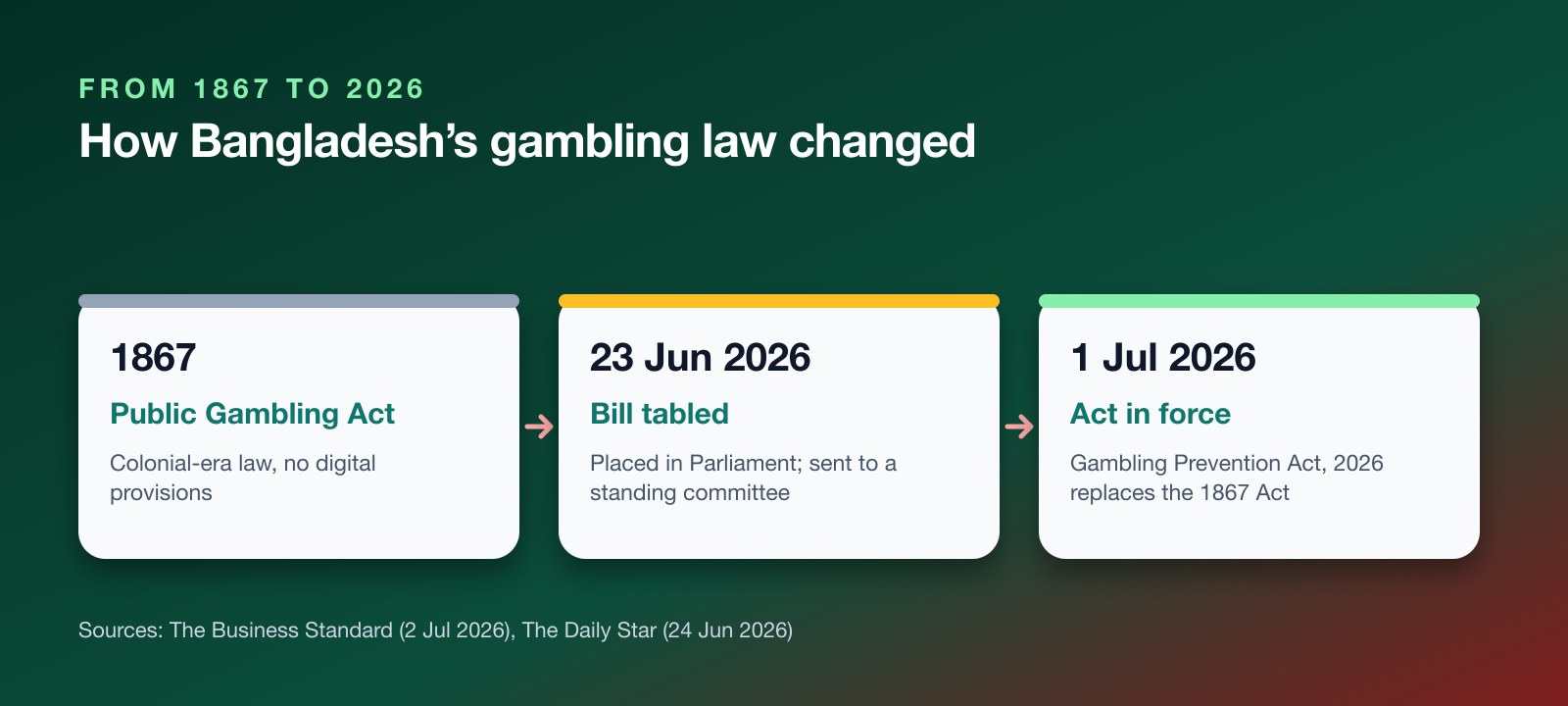
For more than 150 years, Bangladesh relied on the Public Gambling Act of 1867, a colonial-era statute written for card dens and street gambling. It said nothing useful about websites, apps or mobile wallets, so enforcement against online betting leaned on other tools, chiefly website blocking by the telecom regulator BTRC.
According to The Business Standard, the Gambling Prevention Act, 2026 took effect on 1 July 2026, after publication in the official gazette following the President’s assent, and it replaces the 1867 Act. The Daily Star had reported the earlier steps: the Home Minister placed the bill in Parliament on 23 June 2026, and it was sent to a parliamentary standing committee with five working days to report. In other words, the law moved from introduction to being in force within about a week.
What the Act covers
The reporting we read describes a law that is deliberately broad. It reaches:
- Online and remote gambling, including online betting, sports betting and virtual casinos.
- Technical facilitation: running gambling services through VPNs, proxy networks, mirror sites, hosting, domain or cloud services is treated like operating the platform.
- Payments: moving, hiding or legitimising gambling proceeds through banks, mobile financial services, digital wallets, hawala, hundi or cryptocurrency is described as a predicate offence under the Money Laundering Prevention Act, 2012.
- Identity abuse: gambling through fake or “ghost” SIMs, fake mobile-money accounts, or someone else’s national ID or biometric data carries its own, heavier penalty.
- Sport integrity: match-fixing and spot-fixing.
- Promotion: advertising, sponsorship, affiliate marketing and referral campaigns.
The Act also gives the state tools designed for the digital era. The reports describe artificial-intelligence monitoring, deep packet inspection of internet traffic, transaction monitoring, a national digital blacklist of SIMs, accounts, devices, domains and apps, and a system linking national ID, SIM registration and financial accounts. The agencies named include the Home Ministry, the ICT ministry, BTRC, Bangladesh Bank, the Financial Intelligence Unit (BFIU), the Election Commission, the CID and the National Cyber Security Agency.
Read this before assuming a site is “fine”. Many betting sites still accept sign-ups from Bangladesh. That is a statement about the operator, not about the law. Under the Act as reported, the person who places the bet is exposed too.
Penalties, as reported
Penalties are the part where sources need the most care, because the bill changed on its way through Parliament and outlets summarised it differently. The table uses The Business Standard’s report of the Act as enacted, and notes where the Daily Star’s description of the draft added detail. Amounts are in taka; 1 crore is 10 million and 1 lakh is 100,000.
| Conduct | Penalty reported |
|---|---|
| Operating an online gambling or betting platform, acting as a bookmaker, or facilitating through VPNs or mirror sites | Up to 7 years and up to Tk 5 crore |
| Organised gambling, or laundering through fake SIMs, fraudulent mobile-money accounts or crypto | Up to 10 years and up to Tk 5 crore |
| Individual involved in online gambling | Up to 5 years or up to Tk 1 crore |
| Conventional (offline) gambling | Up to 2 years, up to Tk 2 lakh, or both |
| Gambling using fake SIMs or accounts, or another person’s ID or biometrics | Up to 7 years and up to Tk 50 lakh |
| Match-fixing / spot-fixing | Up to 7 years and Tk 1 crore / up to 5 years and Tk 50 lakh |
| Advertising, sponsorship, affiliate or referral promotion | Up to 3 years, up to Tk 50 lakh, or both |
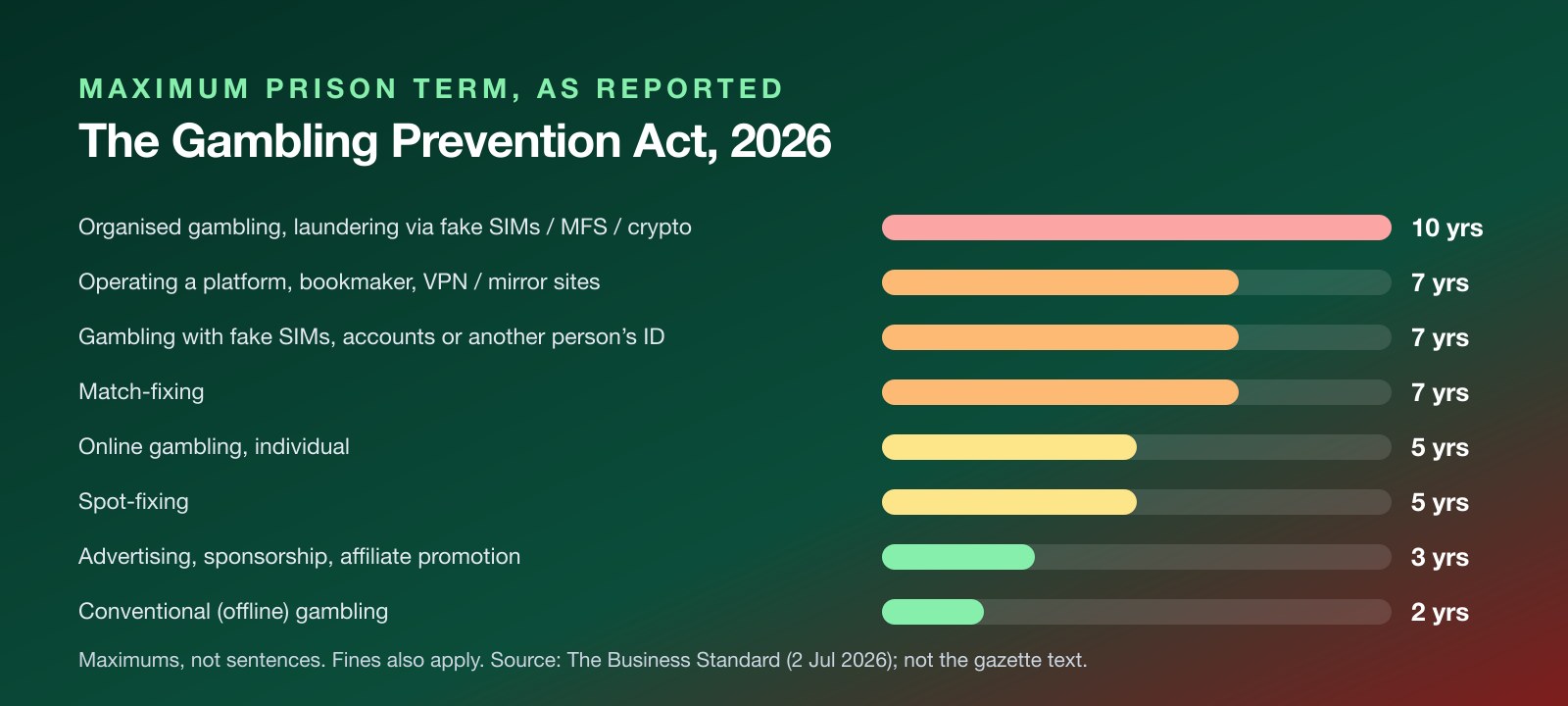
Two further points from the reporting. The Daily Star’s account of the draft said repeat offenders face doubled maximum penalties; we could not confirm that this survived into the enacted text. And all offences are described as cognisable, non-bailable and non-compoundable, with cyber-related cases going to Cyber Tribunals. A “maximum” is not a sentence: courts decide, and we have no data on how the Act is being applied in practice.
What it means if you are a player
This is different from some other markets we cover. In India, for example, the law targets those who offer or advertise online money games, and commentators say players are not the target. Bangladesh’s Act, as reported, names the individual who gambles online as an offender, with a maximum of up to five years or a fine up to Tk 1 crore.
The practical risks go beyond the criminal penalty:
- Account freezing and confiscation. Courts may confiscate bank accounts, mobile-money accounts, wallets, crypto assets, devices and SIMs linked to gambling. A freeze can hit money that has nothing to do with betting if the same account was used.
- No consumer protection. An operator that is unlicensed in Bangladesh has no local regulator to complain to. If a withdrawal is refused, there is nowhere official to go, and reporting it could mean reporting yourself.
- Identity risk. Never register or deposit using another person’s SIM, national ID or mobile-money account. That is the conduct the Act treats most severely, and it also exposes the person whose identity you used.
- Scams exploit the situation. Fake “agents”, fake betting apps and “withdrawal fee” demands thrive where victims feel unable to report.
bKash, Nagad, Rocket and bank accounts
Many articles still ask which betting site accepts bKash. The honest answer is that the payment channel those pages rely on has been under direct pressure since at least 2023.
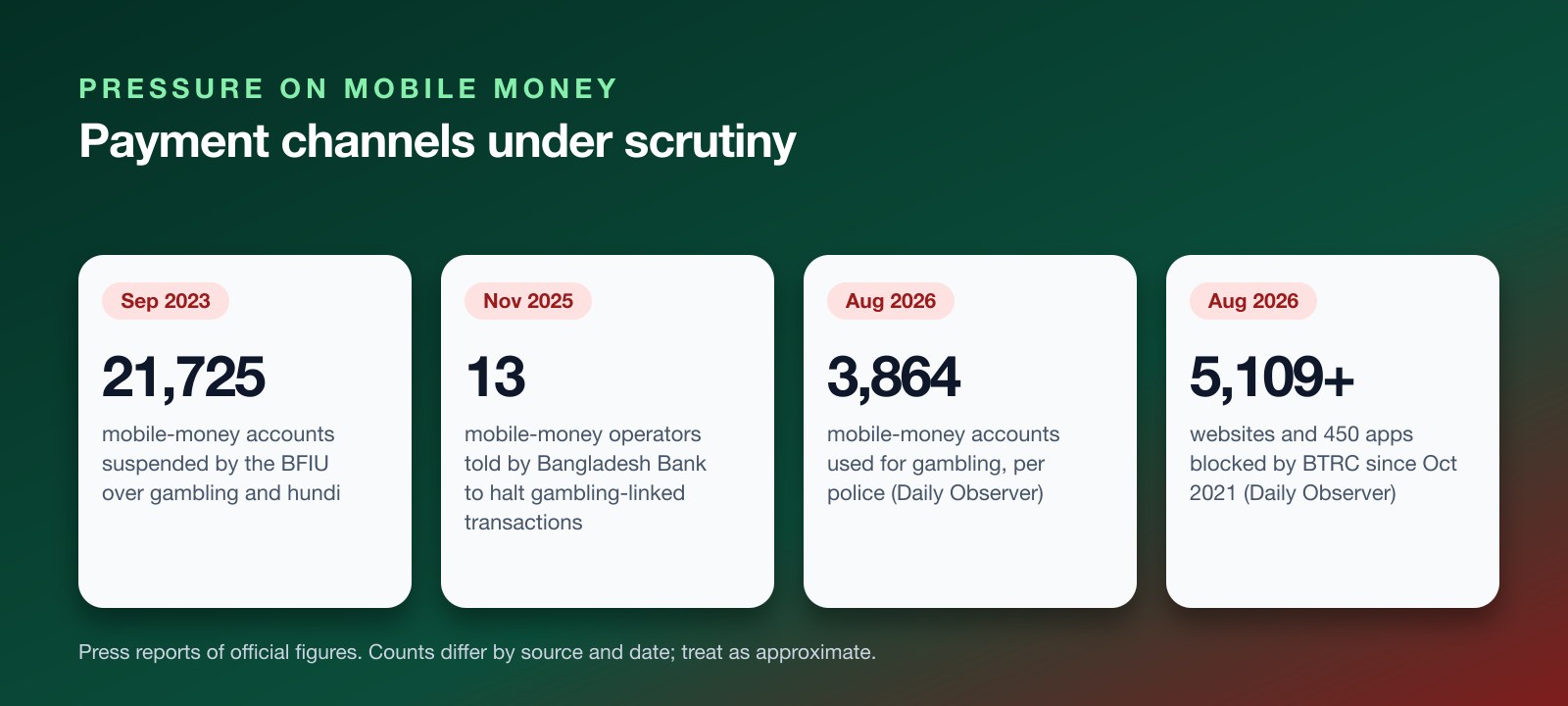
- In September 2023, the BFIU suspended 21,725 mobile-money accounts over alleged involvement in online gambling and hundi. The Business Standard reported that most were bKash, Nagad and Rocket accounts, with no breakdown by provider. The BFIU also sent law enforcement a list of 814 websites, 159 apps and 442 social-media pages and links.
- In November 2025, Yogonet reported that Bangladesh Bank, following instructions from the ICT Division, sent letters to 13 mobile-financial-service operators. They were told to halt transactions linked to online gambling, compile lists of suspected accounts, set up monitoring task forces, use AI tools to flag unlawful transfers and open public complaint channels. We have not read the letters themselves.
- In August 2026, the Daily Observer quoted police saying about 3,864 mobile-money accounts were being used for gambling, and described agents allegedly collecting proceeds through bKash, Rocket and Nagad using rented accounts.
bKash told reporters it already reports suspicious transactions to the BFIU, and Nagad said it does not process payments for unlicensed entities. Neither statement means a given betting site can accept your wallet. Treat any page promising a smooth bKash or Nagad betting deposit with suspicion: the provider may block it, the account may be flagged, and the Act’s money-laundering provisions apply to payment flows.
Blocked sites and why they keep returning
Website blocking is not new. The Daily Observer (26 August 2026) cites officials saying the telecom regulator BTRC has blocked at least 5,109 gambling websites and 450 apps since October 2021, and that police believe about 586 gambling websites are currently active. Other outlets quote different totals because they cover different dates and count different things, so treat any single figure as approximate.
The pattern behind the numbers is consistent across the reporting: lists of sites go from the Cyber Police Center to BTRC, sites are blocked, and operators return on new domains, mirror sites and apps. Many users reach blocked sites through VPNs. The 2026 Act responds to that by treating VPN and mirror-site facilitation as part of the offence, but nothing we read shows blocking has become reliable. For a player, the lesson is simple: a site that works today can be blocked tomorrow with your balance on it.
Advertising, affiliates and influencers
The Act, as reported, makes gambling advertising, sponsorship, affiliate marketing and referral campaigns an offence, with up to three years in prison, a fine up to Tk 50 lakh, or both. It names media outlets, platforms, influencers, artists and athletes. A 2022 High Court ruling against online gambling ads, reported by The Daily Star, saw limited enforcement.
For readers, this is a reason to distrust the flood of “top betting sites in Bangladesh” pages, YouTube videos and social-media posts. Many are affiliate content. We are an affiliate-funded site ourselves, which is why we explain how that works on our philosophy page and why we say plainly what we can and cannot tell you here.
What we could not verify
- The Act’s official text. We read press reports of the enacted law and of the draft. We did not find the gazette text, so penalty details could differ in small ways.
- Licensing. None of the reports we read describe any licence, permit or legal route for a gambling operator. We would report one if it existed.
- Blocking powers. The reports describe a national blacklist and a role for BTRC, but did not spell out how blocking decisions are triggered or reviewed.
- Enforcement so far. We found no reliable data on prosecutions of ordinary players under the new Act.
- Local help services. We have not verified a Bangladeshi gambling-helpline, so we do not list one.
How AskBigBonus handles Bangladesh
AskBigBonus is an information site. We do not operate or offer gambling, and being listed on our pages is not a statement that an operator is legal in your country. Our Bangladesh pages describe which operators say they accept players from Bangladesh, what we could verify about them, and the legal position summarised here. If you want a clean rule: availability is not legality.
We keep commercial relationships separate from editorial scoring, as described on our philosophy page and in our Trust Score method. Where a country’s law changes as sharply as Bangladesh’s did, we would rather tell you the risk than rank sites as if nothing happened. For how licences normally work, see our beginner’s guide to gambling licences.
If you have already used a betting site
- Stop depositing and do not chase losses or “recover” funds through anyone who contacts you first.
- Do not use anyone else’s SIM, ID or wallet, and do not let others use yours.
- Keep records of transactions. They matter if an account is frozen or you are a victim of fraud.
- Be careful with “withdrawal fees”. A site that asks you to pay more to release your balance is almost certainly a scam.
- Get legal advice from a qualified Bangladeshi lawyer if your account has been frozen or you are contacted by an authority. Nothing here replaces that.
- If gambling is harming you, talk to someone you trust and to a doctor or counsellor. Gambling can be addictive, and it is for adults only.
Sources
All pages were opened on 17 October 2026. Where an outlet blocked our access we did not cite it.
- The Business Standard: Bangladesh enacts new anti-online gambling law (2 July 2026): in force 1 July, scope, penalties, enforcement.
- The Daily Star: Inside Bangladesh’s new gambling bill (24 June 2026): the bill as introduced, AI surveillance, blacklists.
- The Daily Observer (26 August 2026): BTRC blocking figures, mobile-money accounts used for gambling.
- The Business Standard: BFIU suspends 21,725 MFS accounts (27 September 2023).
- Yogonet (6 November 2025): Bangladesh Bank letters to 13 mobile-financial-service operators, and what they required.
Frequently asked questions
Is online betting legal in Bangladesh?
No. The Gambling Prevention Act, 2026, in force since 1 July 2026, criminalises operating, promoting and taking part in online gambling. The reports we read describe no licensing route for gambling operators.
Can I be punished for betting online?
As reported, yes. The Act describes penalties for individuals involved in online gambling of up to five years in prison or a fine of up to Tk 1 crore. Courts decide actual sentences, and we found no data on how often players are prosecuted.
Can I use bKash or Nagad for betting sites?
We would not rely on it. Authorities have suspended tens of thousands of mobile-money accounts over gambling and hundi, and Bangladesh Bank has reportedly told providers to halt gambling-linked transactions. A site accepting these wallets does not make the payments safe or lawful.
Why are betting sites still accessible if they are illegal?
BTRC blocks sites, but operators return on new domains and apps, and many users use VPNs. The new Act treats VPN and mirror-site facilitation as an offence, but access has not stopped. A site working is not evidence that it is legal.
Are affiliate and “top betting sites” pages legal?
The Act, as reported, makes gambling advertising, sponsorship, affiliate marketing and referral campaigns an offence with up to three years in prison. Treat such pages with caution, including ours: we are an information site and say clearly that availability is not legality.
Is crypto betting allowed?
No separate exception was described. The reports say moving or hiding gambling proceeds through cryptocurrency is a predicate offence under the money-laundering law, and that the Act covers crypto transactions.
Where can I check the current law?
The authoritative source is the official gazette text of the Gambling Prevention Act, 2026 and the Bangladesh Parliament and Ministry of Law publications. We could not locate the gazette text, so ask a Bangladeshi lawyer for the current wording.
Written by
Editorial team
AskBigBonus Editorial is the byline for articles prepared by the AskBigBonus editorial team. It is a team byline, not a single person, and we use it for guides and explainers that rely on public documents rather than a named reporter's firsthand experience. How an article is made. We start with the primary source: the regulator's own pages, the official gazette or the tax authority's service page. Where the official text is not public, we use law-firm client alerts and established press and say so in the article. We then compare the facts with the AskBigBonus operator database and note what could not be verified instead of filling the gap. Every article lists its sources and the date we last reviewed it. What we do not claim. We do not say we tested an operator with real deposits or withdrawals unless the article says so and shows the evidence. Articles are general information, not legal, tax or financial advice. Commercial relationships. AskBigBonus may earn a commission from some operators we mention. That does not decide our scores or the order of our rankings; the methodology explains how scores are built. Corrections. If something is out of date or wrong, tell us through the contact page . We correct the article and update its review date.
How we research and scoreWhy AskBigBonusReport a correction
Expertise: Gambling regulation, Licensing and licence checks, Payments and payouts, Bonus terms, Responsible gambling