
CFTC Gives Prediction Markets 30 Days to Drop State Blocks as Courts Order the Opposite
The US regulator that oversees futures markets has told sports prediction markets to stop blocking customers by state, or explain in writing why they cannot. The Commodity Futures Trading Commission (CFTC) issued the guidance on 5 November 2026, giving exchanges 30 days to remove geographic restrictions, which puts the deadline at around 5 December. The move lands in the middle of a legal fight in which federal courts have gone the other way, and it leaves platforms like Kalshi, Polymarket and Crypto.com caught between a federal regulator and state judges.
At a glance · Reported 10 November 2026
The CFTC geofencing guidance at a glance
- United States
- Sports event contracts
- Federal vs state
The short answer
On 5 November 2026 the CFTC told prediction-market exchanges to remove geographic restrictions within 30 days or explain in writing why they cannot, while federal courts, including the Ninth Circuit on 4 November, have ordered Kalshi to geofence. The conflict is unresolved. For players, a prediction market is not a state-licensed sportsbook, availability can change overnight, and the early-December date is calculated, not quoted from the CFTC.
For bettors in the United States, this is more than a procedural squabble. It decides who can legally offer sports-style contracts in which states, whether the protections of a state-licensed sportsbook apply to them, and what happens to money you place on a platform that a court has ordered to stop serving your state. This article lays out what the CFTC actually said, what the courts have decided, what we could and could not verify, and what players should check before using a prediction market.
What the CFTC said
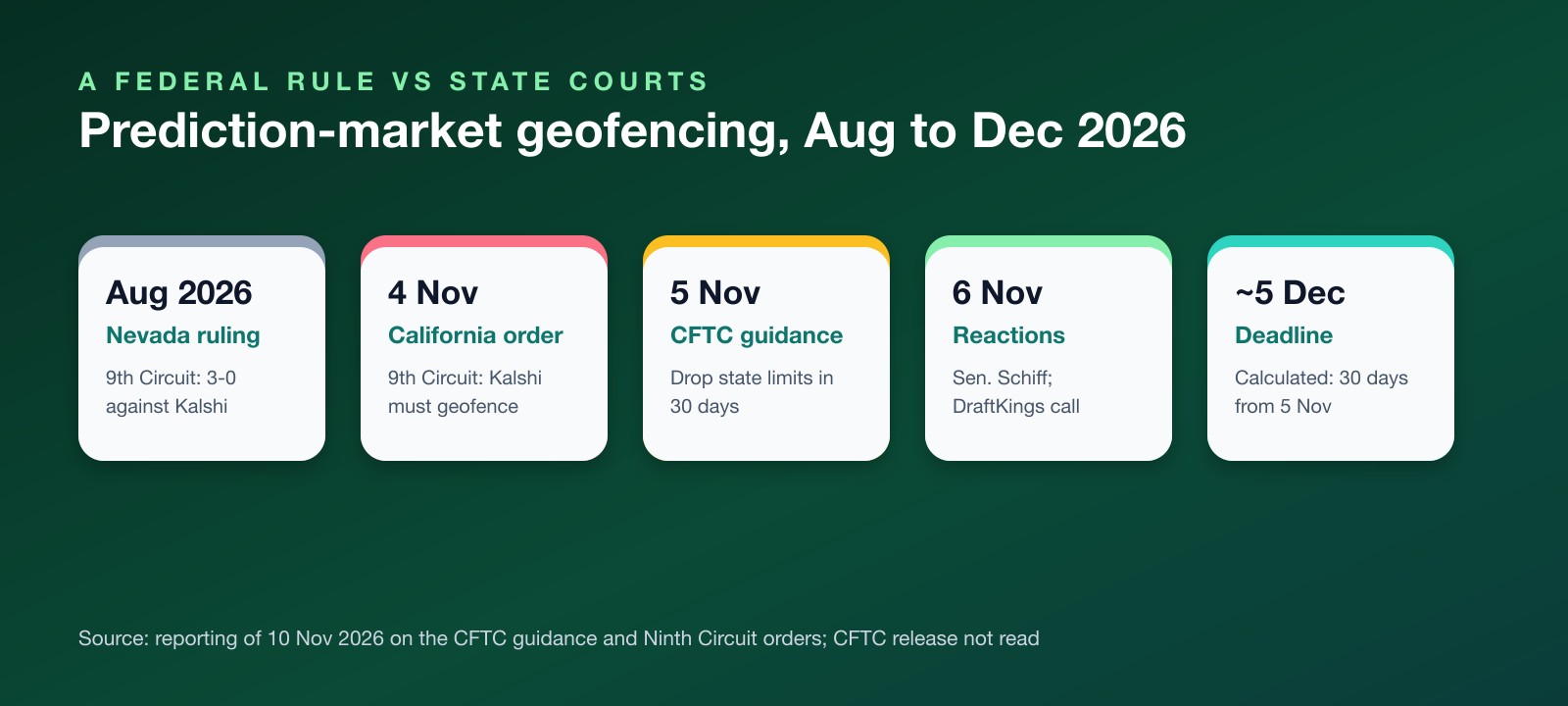
According to reporting published on 10 November 2026, the CFTC guidance gives prediction-market exchanges two options: remove the geographic restrictions they apply within the United States within 30 days, or send a written explanation to the Commission's Division of Market Oversight saying that doing so is not feasible. The guidance is based on a CFTC regulation, 38.151(b), which requires designated contract markets to give competitive, open, fair and impartial access to their markets. CFTC Chairman Michael Selig said geographic access restrictions are inconsistent with those purposes and with the access requirements in the law.
Two details are worth noting. First, the reporting says the guidance does not address what an exchange should do if a court has ordered it to geofence, and it lists no penalties for non-compliance. Second, the 5 December figure is simple arithmetic of 30 days from the guidance date, not a date quoted by the CFTC itself. We were not able to read the CFTC's own press release, so the exact deadline should be confirmed against it.
The reaction was immediate. Senator Adam Schiff of California described the guidance as the CFTC's most egregious attempt yet to undermine state law, the tribes and now the courts, in a post dated 6 November.
Why state limits exist in the first place
Prediction markets sell event contracts, for example a contract that pays out if a team wins. When those contracts are about sports, they resemble a bet. States that license sportsbooks, collect taxes on them and require responsible-gambling tools have argued that platforms offering sports contracts without a state licence are running unlicensed gambling. The platforms respond that they are federally regulated exchanges and that federal law overrides state gambling rules.
The CFTC has sided with the platforms. Reporting says that earlier in 2026 the Commission told Kalshi to honour trades placed in Michigan even though a state court had ordered them cancelled, in July, and that in August it issued an emergency declaration telling Kalshi to keep operating in New York despite state orders to stop. Kalshi's head of enforcement said the July instruction put the company in an impossible position. We could only confirm those episodes in a single report, so we treat them as reported rather than established.
What the courts have decided
The courts have been less sympathetic. The reporting says the US Court of Appeals for the Ninth Circuit ruled 3-0 against Kalshi in a Nevada case in August, rejecting the argument that it could not follow both state geofencing orders and federal access rules and calling that a false, all-or-nothing proposition. On 4 November, the same court ordered Kalshi to geofence its contracts in California, to keep them off tribal lands.
| Source of authority | Position |
|---|---|
| CFTC (federal) | Geographic limits conflict with open and impartial access rules; remove them within 30 days or explain |
| Ninth Circuit | Rejected an all-or-nothing argument in Nevada (August) and ordered California geofencing (4 November) |
| State courts and regulators | Orders in Michigan, Nevada and Washington require geofencing |
| Licensed sportsbooks (DraftKings) | Says it is not making anything of the guidance; no event contracts where it holds sports wagering licences |
The same report says court orders in Michigan, Nevada and Washington require platforms to geofence users. It also says Kalshi, Polymarket and Crypto.com have pulled sports event contracts from states such as Michigan after court rulings. Other coverage describes a patchwork across the country, with different outcomes in different federal circuits and state courts. We do not repeat state-by-state availability here, because it changes quickly and the tables we saw were internally inconsistent about their own dates.
The collision is now clear. A federal regulator says exchanges should not block users by state. Federal appeals judges say exchanges must block users in particular states. An exchange cannot comply with both, which is why the guidance's silence on court orders is the part regulators and lawyers are focused on.
What the sportsbooks are saying
The established, state-licensed sportsbooks have not treated the guidance as a threat. On 6 November, on DraftKings' third-quarter earnings call, chief executive Jason Robins said he would not make anything of the CFTC development, and added that the company has a good relationship with the CFTC. DraftKings holds designated contract market status but, according to the reporting, does not offer sports event contracts in states where it holds sports wagering licences. That position, keeping licensed betting and federally regulated contracts separate, is one of the more conservative ways to manage the conflict.
What this means for players
If you are a US bettor, the legal ground is not settled, and the answers depend on where you live and which product you use. A few practical points follow.
- A prediction market is not a state-licensed sportsbook. A licensed sportsbook is overseen by a state regulator, which sets rules on advertising, self-exclusion, complaints and consumer protection. A federally regulated exchange operates under a different set of rules, and the protections are not the same.
- Availability can change overnight. A court order can switch a market off in your state. Check the platform's own state list before you fund an account, and check again before you place a position.
- Understand what happens to open positions. If a contract is pulled from your state while you hold it, find out in advance how it is settled and when you get your money back.
- Look for responsible-gambling tools. Some platforms offer deposit limits and self-exclusion, and others do not. Do not assume they exist.
- You are responsible for complying with local law. The platforms say so in their terms, and a CFTC position does not change what your state says.
For betting that sits inside the state-licensed system, our United States country page covers the legal position and how regulation differs from state to state. For background on how licences protect you, see our beginner's guide to gambling licences and the way we score operators in how we calculate a Trust Score.
What we could not verify
We want to be clear about the limits of this report. We relied mainly on one published account of the CFTC guidance and the surrounding litigation, and we could not read the CFTC's own release. Other coverage mentions a bill in the Senate that would restrict sports contracts unless a state or tribe approves them, and a lawsuit and legislation in New York, but we could not confirm the details of either, so we have left them out. Trading-volume comparisons between prediction markets and sportsbooks also appeared in coverage, and we have not repeated them because we could not check the source. If you rely on any figure for a decision, go back to the primary documents: the CFTC release, the court orders and each platform's own state-availability page.
What to watch next
The next few weeks have three clear checkpoints. The first is the 30-day window itself: whether exchanges drop their geographic limits, send written explanations, or do neither. The second is whether any court treats the guidance as relevant to the geofencing orders already in place. The third is whether the dispute reaches the Supreme Court, which would be the point at which the question of whether federal exchange rules override state gambling law gets a final answer.
Until then, the safest assumption for a player is that the rules differ by state, change often, and are being decided in court. That is a good reason to prefer clearly licensed products, to read the terms, and to keep any exposure to a platform whose status is contested at a level you are comfortable losing.
Frequently asked questions
What did the CFTC announce on 5 November 2026?
It issued guidance telling prediction-market exchanges to remove geographic restrictions within 30 days, or explain in writing why they cannot. The guidance relies on a rule requiring open and impartial access to designated contract markets.
When is the deadline?
Reporting puts it around 5 December, 30 days after the guidance. That date is calculated rather than quoted from the CFTC, so check the Commission's release.
Are sports prediction markets legal in my state?
It depends on the state and the platform, and courts have ordered geofencing in places including Michigan, Nevada, Washington and, for tribal lands, California. Check the platform's current state availability and your state regulator's position.
Is a prediction market the same as a sportsbook?
No. A state-licensed sportsbook is regulated by a state gaming authority. A prediction market on a federally regulated exchange follows different rules and gives different protections.
Does the CFTC guidance affect licensed sportsbooks like DraftKings?
DraftKings said on 6 November it was not making anything of it. Reporting says it does not offer sports event contracts in states where it holds sports wagering licences.
Sources
- Reporting on the CFTC guidance and Ninth Circuit orders (10 Nov 2026)
- CBS Sports: legal status of Kalshi and Polymarket by state
Cover and infographic designed by AskBigBonus. Background photo: Noclip, public domain, via Wikimedia Commons. Facts checked 11 November 2026; each statement is attributed to the reporting it comes from, and anything we could not verify is flagged in the text.
Written by
Editorial team
AskBigBonus Editorial is the byline for articles prepared by the AskBigBonus editorial team. It is a team byline, not a single person, and we use it for guides and explainers that rely on public documents rather than a named reporter's firsthand experience. How an article is made. We start with the primary source: the regulator's own pages, the official gazette or the tax authority's service page. Where the official text is not public, we use law-firm client alerts and established press and say so in the article. We then compare the facts with the AskBigBonus operator database and note what could not be verified instead of filling the gap. Every article lists its sources and the date we last reviewed it. What we do not claim. We do not say we tested an operator with real deposits or withdrawals unless the article says so and shows the evidence. Articles are general information, not legal, tax or financial advice. Commercial relationships. AskBigBonus may earn a commission from some operators we mention. That does not decide our scores or the order of our rankings; the methodology explains how scores are built. Corrections. If something is out of date or wrong, tell us through the contact page . We correct the article and update its review date.
How we research and scoreWhy AskBigBonusReport a correction
Expertise: Gambling regulation, Licensing and licence checks, Payments and payouts, Bonus terms, Responsible gambling