
Binance After the $6.3 Billion Hack: What Happened, What Is Alleged and What Crypto Players Should Do
On 29 October 2026, attackers stole about $6.3 billion in cryptoassets from Binance, the world's largest crypto exchange, in what reporting describes as the biggest crypto heist on record. The FBI has linked the theft to North Korea. Binance says it will absorb the loss rather than its users, and within two weeks the company was also in the news for a different reason: it announced it would stop processing transactions with another exchange, MEXC, after a US Treasury action, while older legal matters over sanctions and past compliance remained open.
At a glance · Reported to 10 November 2026
The Binance hack and its fallout at a glance
- Exchange hack
- FBI attribution
- Laundering
- Legal overhang
The short answer
Attackers stole about $6.3 billion to $6.43 billion from Binance on 29 October 2026, and the FBI has linked the theft to North Korea. Binance says it has replaced 90% of the stolen amount and that its users will not bear the loss. Separate legal matters, including a US review of Binance's 2023 settlement and a Treasury action against another exchange, MEXC, are allegations or agency actions, not findings against Binance. If you use crypto to gamble, keep only what you need on any exchange and be wary of "recovery" scams.
What happened on 29 October
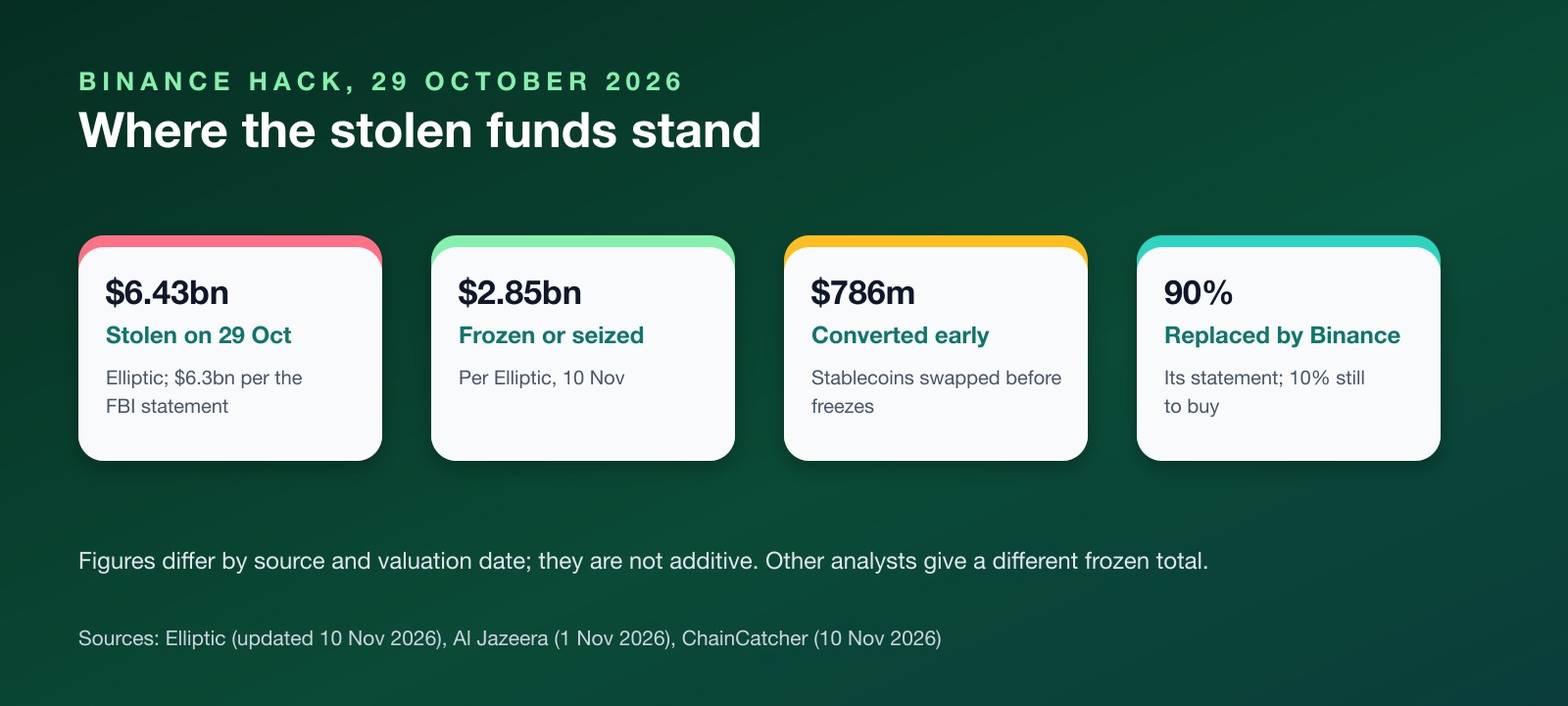
According to blockchain-analytics firm Elliptic, $6.43 billion in cryptoassets was stolen from Binance on 29 October, in a window running from 20:05 to 23:56 UTC. Al Jazeera, reporting the FBI statement, gives the figure as $6.3 billion, and a third analysis citing Onchain Lens gives $6.34 billion. None of the pages we read explains the difference, which is most likely down to prices and valuation dates, so we give each figure with its source rather than choosing one.
How the attackers got in is described differently by different sources. Elliptic describes a multi-stage campaign: in June an engineer installed a tampered copy of an AI coding tool, in September attackers posing as recruiters had another engineer download a malicious "assignment" during a fake job interview, an internal AI tool was then used to reach other engineers' machines, and on 29 October the attackers reached the wallet signing service. Al Jazeera, citing co-CEO Richard Teng on 30 October, describes a complex attack involving a compromised laptop and malicious software designed to delete evidence of its activity. The two accounts are not necessarily in conflict, but the second is a shorter description of the same event.
What was taken
Elliptic's breakdown of the stolen assets shows how mixed the haul was. The largest part, $3.46 billion or 54%, was stablecoins such as USDT and USDC. The rest included Ether ($1.25 billion), 18,270 Bitcoin, 684.6 million TRX, 233 million XRP, about $90 million in Solana and $42 million in NEAR. The mix matters because stablecoin issuers can freeze their tokens, which is what happened next.
| Source | Stolen / frozen figure reported |
|---|---|
| Al Jazeera (FBI statement, 1 Nov) | $6.3bn stolen |
| Elliptic (updated 10 Nov) | $6.43bn stolen; $2.85bn frozen or seized |
| ChainCatcher citing Onchain Lens (10 Nov) | $6.34bn total; $2.6bn frozen; $2.85bn under hacker control; $891m moved or laundered |
Who the FBI blames
The FBI said on Saturday 31 October that it has linked North Korea to the theft, and blamed a group called TraderTraitor, the same group it blamed for a $1.5 billion theft from the Bybit exchange in February last year. It said the stolen assets were being laundered primarily by converting them into Ethereum, expected them to be laundered further in stages, and called on virtual asset service providers to block transactions and watch the addresses it published. We have not read the FBI's own release, and these details come from Al Jazeera and Elliptic.
What Binance has said and done
Binance says it has replaced 90% of the amount stolen by using company money to buy new tokens, with the remaining 10% made up of less liquid tokens that may take longer to buy. In a post on X on 31 October it said it would keep buying the remaining token assets until the covered amount reaches 100% for all tokens, and that it "will absorb the financial impact of these stolen funds, not our users". Al Jazeera reports the money came from a $1 billion Secure Asset Fund for Users (SAFU), part of its Futures Insurance Fund and corporate treasury. Binance stopped customer withdrawals after the hack, said it was on track to reopen them on Sunday 1 November, and published a new proof-of-reserves snapshot showing assets backed at a minimum 1:1 ratio. We found no report of user losses in the sources we could read, and we have not independently confirmed that withdrawals reopened.
Where the money is now
Elliptic's analysis, last updated on 10 November, is the most detailed public account of the laundering. Its main findings:
- $2.85 billion has been frozen or seized, which Elliptic calls unusually high: after the Bybit theft, about 3% was frozen. Tether froze USDT on Ethereum 37 minutes after it arrived, and Circle froze all 823 million USDC before any was swapped.
- About $786 million of stablecoins were converted before the freezes landed.
- About 3,350 BTC (roughly $250 million) sits in new bitcoin addresses, converted from other stolen assets, and about $190 million of XRP was swapped.
- The attackers used over 20,000 wallets on 16 blockchains, at least 36 services and at least 65,000 transactions, including THORChain swaps, bridges, mixers and worthless meme tokens traded in liquidity pools.
- A negligible amount has likely been cashed out, Elliptic says, and it expects Ether to be swapped to Bitcoin and sold through over-the-counter brokers over months.
Other analysts report different totals. A 10 November analysis citing Onchain Lens estimates $891 million may have been moved or laundered, and gives $2.6 billion as frozen and $2.85 billion as still under the hacker's control, which is the reverse of Elliptic's numbers for those two categories. They are measuring different things, so the figures should not be added together. The theft's laundering routes are not settled, either. A Bloomberg headline of 5 November says funds flow to Chinese laundering networks, citing Chainalysis, but we could not read the article. Elliptic says the funds may already be with Chinese money-laundering networks and that on-chain data cannot show whether that has happened.
The wider picture: MEXC, Iran and older cases
The hack is separate from the other legal and regulatory stories around Binance, but players often see them together, so it is worth keeping them apart. These are allegations and agency actions, not court findings against Binance, unless stated.
MEXC and FinCEN
On 10 November, Binance announced it would stop processing transactions with MEXC and related entities. Secondary reports say the US Treasury's FinCEN issued an order on 6 November under section 9714 of the Combating Russian Money Laundering Act, naming MEXC a primary money-laundering concern and assessing at least $16 billion to $16.7 billion in illicit flows between May 2021 and May 2026, including about $1.5 billion tied to Russian sanctions evasion. It takes effect 30 days after publication in the Federal Register. MEXC said on 7 November that it was reviewing the order, was operating normally and that user assets were secure. We could not obtain FinCEN's own document, so these figures are the reported assessments, not a court verdict.
The Iran-related review and forfeiture
Reporting citing Bloomberg says that federal prosecutors in Manhattan and the Justice Department's criminal division are examining whether Binance complied with its 2023 settlement, including potential violations of US Iran sanctions. The head of the DOJ criminal division declined to discuss the facts. Binance says it continues to improve its controls and is fully committed to cooperating, and the reporting adds that Binance and its employees have not been accused of wrongdoing and the case may end without charges. Separately, the Southern District of New York announced in mid-September a civil action seeking forfeiture of $61 million in crypto, naming two Chinese companies that allegedly used Binance trading accounts. Binance was not named as a defendant, and the allegations are unproven unless a court enters judgment.
Older matters
- 2023 plea and fine. On 21 November 2023 Binance pleaded guilty to violating US anti-money-laundering rules and paid a $4.3 billion fine, according to Wikipedia's summary, which elsewhere rounds it to $4 billion. Founder Changpeng Zhao stepped down as CEO. He was later pardoned by President Trump on 23 October 2025.
- FTX estate claim. FTX's recovery vehicles are suing Binance and Zhao in the US bankruptcy court in Delaware, seeking at least $1.76 billion over a 2021 transaction involving Binance's FTX stake. The claim was filed in November 2024 and remains contested; we could not verify reports of a July 2026 ruling.
- RedotPay. Binance is the plaintiff in a Hong Kong petition filed by its affiliates, reported by Bloomberg in August 2026, seeking $472.8 million over alleged misuse of an agreement; RedotPay says it will vigorously defend the claims.
- France. Paris prosecutors announced in January 2025 a judicial investigation into money laundering and tax fraud at Binance for 2019 to 2024. Binance fully denies the allegations.
- SEC case. The SEC sued in June 2023; we could not verify its current status.
What this means for people who use crypto to gamble
A heist at a major exchange does not change how a blockchain deposit works, but it is a reminder of where risk sits. If you fund betting or casino accounts with crypto, a few habits matter more now.
- Do not use an exchange as a bank. Funds on any exchange are exposed to that exchange's security and solvency. Move only what you need and keep the rest in a wallet you control.
- Know what an exchange promises. Binance's pledge to absorb the loss is a company decision, not a legal guarantee that applies to every platform, so do not assume other exchanges would do the same.
- Expect more scrutiny of crypto flows. Freezes, address blocklists and regulator actions can delay withdrawals from casinos and exchanges. Our report on crypto payments and regulatory oversight explains why a confirmed transaction is not always a completed payout.
- Beware of scams that follow headlines. After big breaches, fake "recovery", "compensation" and "verification" messages appear. Binance has said users bear no loss, so there is nothing to claim. Our guide on how to spot fake betting sites and payment scams covers the warning signs.
- Check the casino, not just the coin. A licensed operator with clear withdrawal terms is the safer place to use any crypto. See our best crypto casinos ranking and the Bitcoin Cash payment method page.
What we could not verify
Several items circulating online are not repeated here because we could not read a reliable source for them. These include a claim that a former Binance investigator told the IRS that 2,000 Iran-linked accounts moved $1.2 billion, the Chainalysis and Bloomberg report on Chinese laundering networks, the FBI's own statement, the FinCEN order and its Federal Register date, and the reopening of withdrawals after the hack. Figures differ between sources, and we give each one with its origin. We will update this article as primary documents become available.
Frequently asked questions
How much was stolen from Binance?
About $6.3 billion to $6.43 billion, depending on the source and the valuation used. Al Jazeera reports $6.3 billion and Elliptic $6.43 billion.
Who is blamed for the Binance hack?
The FBI has linked the theft to North Korea and a group called TraderTraitor, according to Al Jazeera. We have not read the FBI's own statement.
Will Binance users lose money?
Binance says it will absorb the financial impact and not its users, and that it has replaced 90% of the stolen amount. We found no report of user losses, but this is the company's statement, not a legal guarantee.
Has any of the stolen money been recovered?
Elliptic says $2.85 billion has been frozen or seized, including all 823 million USDC frozen by Circle, while about $786 million of stablecoins were converted before freezes landed. Another analysis gives different numbers for frozen and controlled funds.
Is Binance accused of fraud or money laundering?
Binance pleaded guilty in 2023 to violating US anti-money-laundering rules. The current Iran-related review, the French investigation and the FTX claim are allegations or contested proceedings, and Binance disputes them. The 2026 hack is a theft from Binance by attackers, not an allegation against Binance.
Should I move my crypto off exchanges?
That is a personal decision, but the general principle is to keep only what you need on any exchange and hold the rest in a wallet you control.
Sources
- Al Jazeera: FBI blames North Korea for record $6.3bn crypto heist (1 Nov 2026)
- Elliptic: How North Korea is laundering the $6.4 billion stolen from Binance
- ChainCatcher: analysis of the Binance hacker's laundering (10 Nov 2026)
- Crypto Briefing: DOJ scrutinizes Binance compliance with its 2023 settlement
- Claims Journal (Bloomberg): Binance claims RedotPay diverted users
- Reuters via Yahoo: French investigators open probe into Binance
Cover and infographic designed by AskBigBonus. Background photo: Zach Copley, CC BY-SA 2.0, via Wikimedia Commons. Facts checked 11 November 2026; each statement is attributed to the reporting it comes from, allegations are described as allegations, and anything we could not verify is flagged in the text.
Written by
Editorial team
AskBigBonus Editorial is the byline for articles prepared by the AskBigBonus editorial team. It is a team byline, not a single person, and we use it for guides and explainers that rely on public documents rather than a named reporter's firsthand experience. How an article is made. We start with the primary source: the regulator's own pages, the official gazette or the tax authority's service page. Where the official text is not public, we use law-firm client alerts and established press and say so in the article. We then compare the facts with the AskBigBonus operator database and note what could not be verified instead of filling the gap. Every article lists its sources and the date we last reviewed it. What we do not claim. We do not say we tested an operator with real deposits or withdrawals unless the article says so and shows the evidence. Articles are general information, not legal, tax or financial advice. Commercial relationships. AskBigBonus may earn a commission from some operators we mention. That does not decide our scores or the order of our rankings; the methodology explains how scores are built. Corrections. If something is out of date or wrong, tell us through the contact page . We correct the article and update its review date.
How we research and scoreWhy AskBigBonusReport a correction
Expertise: Gambling regulation, Licensing and licence checks, Payments and payouts, Bonus terms, Responsible gambling