Finland Grants 12 Online Gambling Licences Ahead of the July 2027 Market Opening
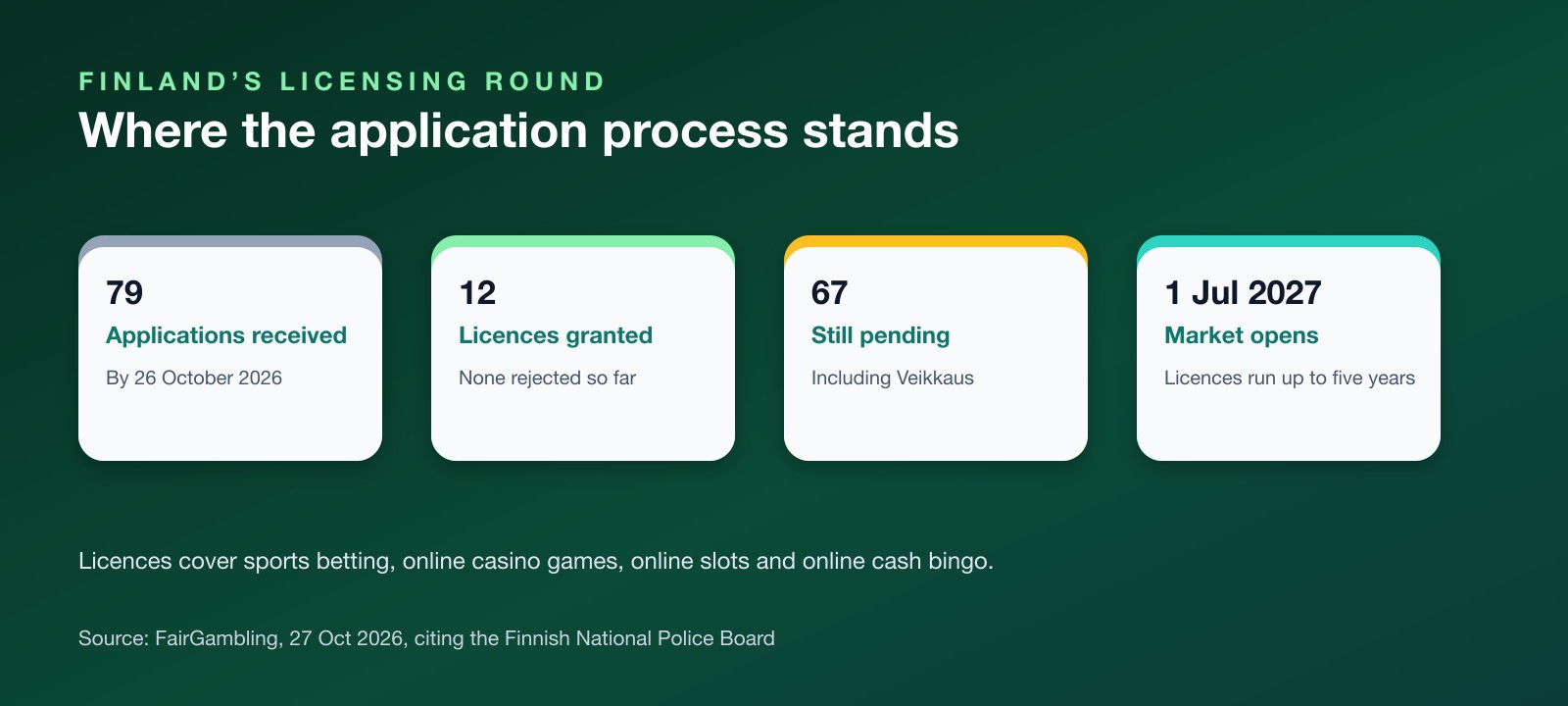
Finland's National Police Board has granted 12 online gambling licences ahead of the country's planned market opening on 1 July 2027, and has not rejected a single application so far. According to FairGambling's report of 27 October 2026, the board had received 79 applications by 26 October, approved 12 and still had 67 pending. One name is conspicuously missing from the approved list: Veikkaus, the state-owned monopoly that has run Finnish gambling for decades.
At a glance · Reported 27 October 2026
Finland's online licensing round at a glance
- National Police Board
- Sports betting
- Casino and slots
- Cash bingo
The short answer
Finland's National Police Board has granted 12 online gambling licences and rejected none of the 79 applications received by 26 October 2026. Private online gambling opens on 1 July 2027, with licences running up to five years for sports betting, casino games, slots and online cash bingo. State monopoly Veikkaus is not among the 12 and keeps lotteries, scratchcards and land-based machines. The tax rate and rules are reported but not yet confirmed against the legislation.
The decisions mark the practical start of the end of the Finnish gambling monopoly for online products. Finland has long been one of the most closed gambling markets in Europe, and the move to a licensing system changes the options open to Finnish players, the obligations on operators and the competitive position of the incumbent. This article summarises who has been licensed, what the licences cover, what we know about the rules that will apply, and what remains unconfirmed.
What has been decided
The licensing authority is Finland's National Police Board. FairGambling reports that applications opened on 1 March 2026 and that, by 26 October, the board had granted 12 licences and rejected none of the 79 applications it had received. Private online gambling is due to open on 1 July 2027, and the report says licences last up to five years. They cover sports betting, online casino games, online slots and online cash bingo.
| Licensee (as reported) | Note |
|---|---|
| Hippos ATG | Announced 19 October; 60% of profits go back to Finnish horse racing and breeding |
| Granturo Finland | Part of the Wildz Group |
| Skill On Net, SuomiVeto, Sunflower Gaming | Named in industry reports of the board's reply |
| Cloudberry Ent, SixthSpin, KuuFlip | Named in industry reports of the board's reply |
| RocketLily Ent, Nivei Ursi, YTBlue, Buccone Trading | Named in industry reports of the board's reply |
The 12 licensees named in the report are Hippos ATG, Granturo Finland (part of the Wildz Group), Skill On Net, SuomiVeto, Sunflower Gaming, Cloudberry Ent, SixthSpin, KuuFlip, RocketLily Ent, Nivei Ursi, YTBlue and Buccone Trading. FairGambling attributes the list to multiple industry reports of the board's reply, rather than to a published register, so we describe the list as reported. As the licences are formally listed, operator names or trading brands may differ from the corporate names shown here.
The Veikkaus question
Veikkaus applied for an online licence, according to the same report, and its application was still pending at the time. It is not among the 12 approved. Veikkaus is expected to keep sole rights to lotteries, scratchcards and land-based gaming machines, so the licensing change affects a defined part of the market rather than the whole of it. The monopoly continues in those areas, while the competitive field is opening in sports betting, casino, slots and cash bingo.
The practical effect for the state operator is significant. Veikkaus has historically faced no domestic competition for online products, and from July 2027 it will compete with private licence holders that include both international groups and Finnish brands. How it fares will depend on its own licence decision, its product and its ability to compete on pricing, bonuses and experience within the rules set for the new market.
Some licensees have a distinctly Finnish character
One of the licensees, Hippos ATG, announced its licence on 19 October. The FairGambling report says that 60% of its profits go back to Finnish horse racing and breeding. That model, in which gambling revenue funds a named public or sporting purpose, is a recognisable feature of Nordic gambling markets and reflects the tradition of channelling proceeds to society that the monopoly was built on. It is also a reminder that the new market will not be a simple replica of the open markets elsewhere in Europe.
Another licensee, Granturo Finland, is part of the Wildz Group. A separate FairGambling report on 16 October said the group had announced approval on 15 October, while noting that it could not confirm the approval with the board at the time. By 27 October the group was in the list of 12. We mention the sequence because it shows how quickly details emerged in the days before the board's response was widely reported, and why initial company announcements should be treated cautiously.
What we know about the rules
The detailed rules have been less clearly reported than the licences, and we have only partial information. That 16 October report, citing Yle, says Finland's tax will be 22% on what operators keep after paying out winnings. It also cites a guide from the law firm Krogerus, saying the rules require strong identity checks for players, a single self-exclusion register covering all licensed operators, and a ban on influencer marketing. These details come from a secondary account of other sources, and we have not seen the text of the law or the board's guidance, so we label them as reported and not confirmed.
If they hold, the combination is meaningful. A single self-exclusion register across all operators is a strong player-protection feature, because it stops someone who has excluded from one site simply moving to another. Strong identity verification limits underage and multi-account play. An advertising restriction on influencers addresses one of the most criticised marketing channels in other markets. Taken together they suggest a regime designed more tightly than some of the early licensing systems in other countries, although the full detail will only become clear when the rules are published and applied.
What it means for Finnish players
For players in Finland, nothing changes today. The new market opens on 1 July 2027, and until then the existing position continues. The practical changes arrive as the opening approaches: more brands will be able to offer licensed products, comparison and review sites will start to list them, and there will be a need to separate licensed operators from sites that are not part of the new system.
That last point is the one we would highlight. Whenever a market moves from a monopoly to licensing, there is a period in which players are uncertain which sites are legitimate, and in which unlicensed sites try to take advantage of the confusion. Our advice is to wait for the opening and then check a site's licence against the regulator's own list before depositing. Do not assume that an operator is licensed in Finland because it holds a licence somewhere else. Our Finland country page tracks the legal position, and our beginner's guide to gambling licences explains what a licence does and does not mean.
What it means for operators
For operators, a licence in hand is the beginning of the work, not the end. The 12 licence holders have until 1 July 2027 to build local products, payment integrations, customer support and compliance processes that meet the rules. Operators that were not among the first 12 will want to know where the 67 pending applications stand, and whether the board will approve them in a steady flow or in batches. The board's decision not to reject any application so far suggests a process that is focused on completeness rather than on limiting the number of licences, although that is an observation about the pattern so far and not a statement of policy.
The 22% tax rate, if confirmed, sets the economic frame. A tax on gross gaming revenue at that level leaves room for competitive odds and bonuses, but it will shape what bonuses and promotions are sustainable. Combined with a ban on influencer marketing, it points toward competition based on product and brand more than on aggressive acquisition spending.
How Finland compares with other opening markets
Finland is not the first country to move from a monopoly to a licensing system, and the pattern elsewhere offers some pointers without predicting the outcome. Markets that open with a defined start date, a clear tax rate and a single self-exclusion register tend to move the conversation from whether private operators should be allowed to how well they are supervised. The licences granted so far give the Finnish regulator a working group of operators to supervise from day one, and the gap between approval and opening gives it time to test their systems before real players arrive. The risks are the familiar ones: the pull of unlicensed sites during the transition, the pressure on the incumbent, and the challenge of making responsible-gambling tools work across many brands at once. How the board handles the remaining applications, and how it enforces the rules once the market is live, will tell us more than the first 12 approvals do.
What is still unconfirmed
Several things remain open. We have not seen the board's own list of licences, so the names above are as reported. We have not verified the tax rate, the advertising rules or the self-exclusion register against the legislation itself. And we do not know how the 67 pending applications, including Veikkaus's, will be decided, or when. We will update this article when the board publishes its register or the final rules.
Frequently asked questions
When does the Finnish online gambling market open?
Private online gambling is due to open on 1 July 2027, according to reporting on the licensing round.
How many licences have been granted?
The National Police Board had granted 12 licences and rejected none of the 79 applications received by 26 October 2026, with 67 still pending, according to FairGambling.
Does Veikkaus have an online licence?
Not as of the reporting we saw. Veikkaus applied and its application was pending. It is expected to keep sole rights to lotteries, scratchcards and land-based gaming machines.
What products do the licences cover?
Sports betting, online casino games, online slots and online cash bingo, for up to five years.
What is the tax rate?
A secondary report citing Finnish broadcaster Yle gives 22% of what operators keep after paying out winnings. We could not confirm this against the legislation.
Sources
- FairGambling: Finland approves 12 online gambling licenses (27 Oct 2026)
- FairGambling: Wildz Group first Finland gambling license (16 Oct 2026)
- Finnish Police: licences under the Gambling Act
Cover and infographic designed by AskBigBonus. Background photo: JIP, CC BY-SA 4.0, via Wikimedia Commons. Facts checked 11 November 2026; each statement is attributed to the reporting it comes from, and anything we could not verify is flagged in the text.