
How to Read Betting Odds: Formats, Implied Probability and the Bookmaker Margin (With Worked Examples)
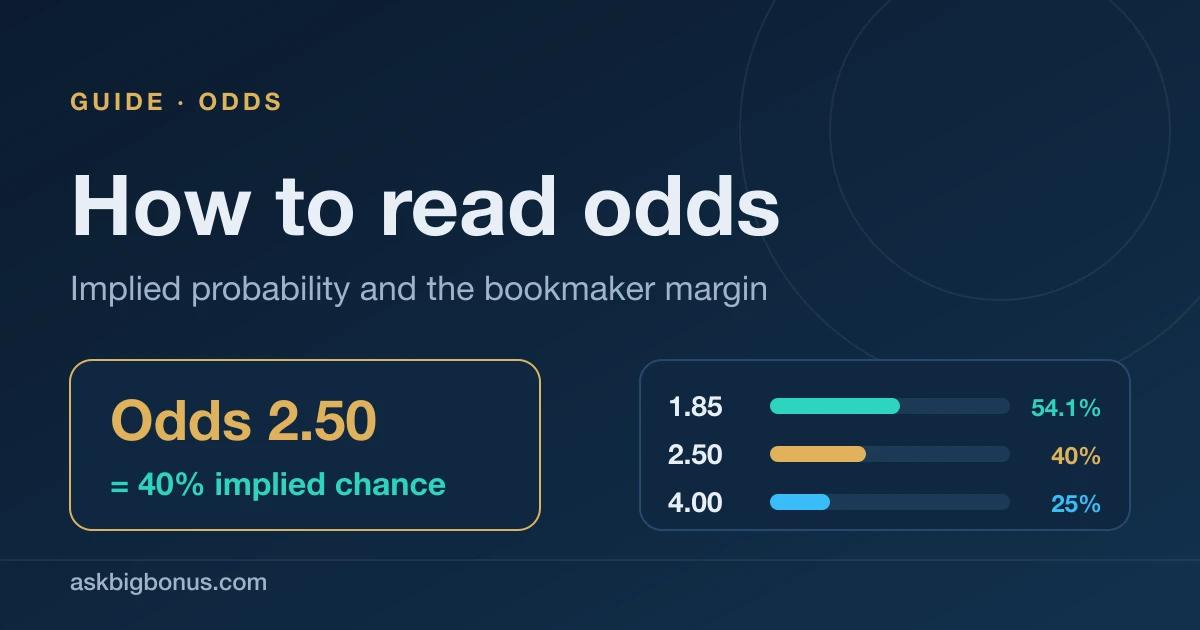
The first time you open a betting site you see numbers like 1.85, 2.40 or 3.60 beside every outcome. Those numbers are the odds, and understanding them is the most basic and most useful skill for anyone who follows sports betting. They show what a bet pays, but they also reveal the probability the bookmaker assigns to each outcome and how much it charges for offering the market.
This guide explains, in plain language and with worked examples, how to read the three odds formats, how to turn odds into implied probability, what the bookmaker margin (the overround) is, how the idea of a value bet works and why accumulators raise the built-in cost. It is educational content: it does not recommend any betting site and does not promise profit, because no technique removes the risk of losing money.
At a glance · Educational content
Odds in a few numbers
- Decimal odds
- Implied probability
- Bookmaker margin
- Expected value
The short answer
Decimal odds show your total return per unit staked: stake multiplied by the odds gives the return, and profit is the return minus the stake. To find the probability the odds imply, divide 1 by the odds: odds of 2.50 imply 40%. When you add up the implied probabilities of every outcome in a market the total is above 100%, and that surplus is the bookmaker margin, the built-in price you pay for the market.
What odds are and what they are for
Odds are the numbers betting sites use to price every possible outcome of an event: home win, draw, away win, over or under 2.5 goals, and so on. They do two jobs at once. The first is to work out what you are paid if the bet wins. The second is to communicate a probability: the shorter the odds, the more likely the bookmaker thinks the outcome is; the longer the odds, the less likely.
That means odds are never a neutral forecast. They come from a statistical model, from the volume of money taken and from a margin the bookmaker builds in so that it earns revenue whatever the result. Learning to read odds is therefore the first step to seeing what sits behind them instead of looking only at the possible payout.
Odds also move. They shift as news arrives (an injury, a team sheet), as money comes in on one side and as a match unfolds, in the case of live betting. The price you see is the price that applies at the moment the bet is confirmed.
The three odds formats: decimal, fractional and American
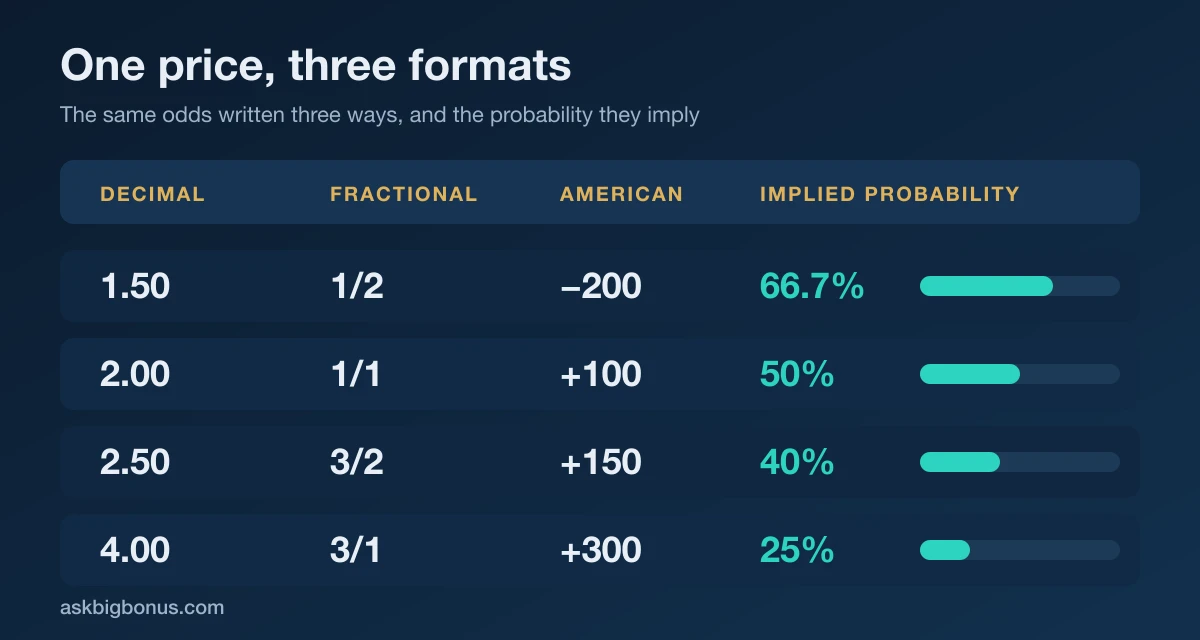
The same information can be written three ways. Knowing all of them helps when you read analysis from other countries or compare sites that let you switch format in your account.
Decimal odds (the standard in Brazil and most of Europe)
Decimal odds already include your stake in the return. Odds of 2.50 mean every 1 staked returns 2.50 if you win: 1.50 profit plus your own 1.00 back. It is the simplest format and the one used in the examples in this guide.
Fractional odds (common in the United Kingdom)
Fractional odds show the profit relative to the stake. Odds of 5/2 ("five to two") pay 5 profit for every 2 staked. To convert to decimal, divide the numerator by the denominator and add 1: 5 ÷ 2 + 1 = 3.50. Other examples: 1/4 becomes 1.25 and 11/10 becomes 2.10.
American odds (common in the United States)
American odds use a sign. A positive number shows how much you win on a 100 stake: +150 pays 150 profit per 100, equal to 2.50 in decimal. A negative number shows how much you must stake to win 100: −200 means staking 200 to profit 100, equal to 1.50.
- Positive to decimal: odds ÷ 100 + 1. Example: +150 → 2.50.
- Negative to decimal: 100 ÷ |odds| + 1. Example: −200 → 1.50.
Whichever format you use, the underlying maths is identical. Only the way it is written changes.
How to calculate return and profit
With decimal odds the sums are direct:
- Total return = stake × odds
- Profit = total return − stake
Example: you stake 40 at odds of 2.25. If it wins, the total return is 40 × 2.25 = 90 and the profit is 50. If it loses, you lose the 40 staked. A single bet has no middle result: it is the full return or nothing.
One caveat is that the return does not account for any tax or fees that may apply to winnings. Taxation of betting is a separate subject and depends on the rules in force where you live, so always confirm the conditions with the operator and with official sources.
Implied probability: what the odds say about the chances
Implied probability is the chance the odds suggest, and the formula is one of the most useful in betting:
implied probability = 1 ÷ decimal odds
A few examples:
- Odds 2.50 → 1 ÷ 2.50 = 0.40, or 40%.
- Odds 2.00 → 1 ÷ 2.00 = 50%.
- Odds 1.50 → 1 ÷ 1.50 = 66.7%.
- Odds 4.00 → 1 ÷ 4.00 = 25%.
This also gives each bet's break-even point. At odds of 2.00 you only come out even over the long run if you win 50% of the time. At odds of 1.50 you need to win roughly two in every three. Anyone who bets often at short odds needs a high strike rate, because every loss wipes out the profit of several wins.
Note that implied probability is not true probability. It is the probability the bookmaker is charging for, with the margin already included, as the next section shows.
The bookmaker margin (overround): what the market costs
If odds reflected only true probabilities, the probabilities of every outcome in a market would add up to exactly 100%. In practice they add up to more. That surplus is the bookmaker margin, also called the overround or vig, and it is how a bookmaker earns revenue even when a result is unpredictable.
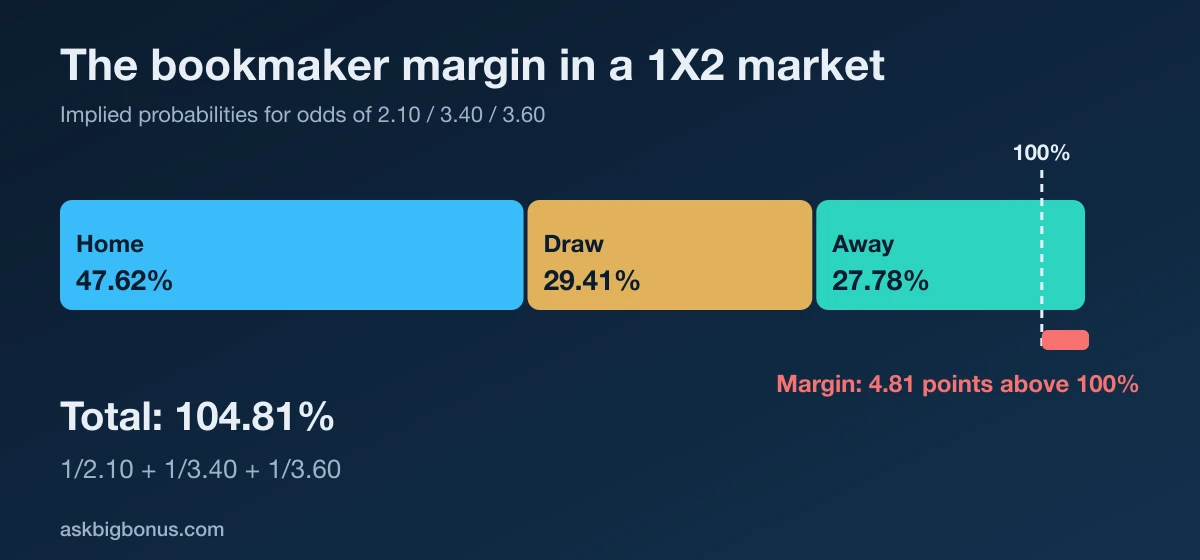
Here is a 1X2 market (home win, draw, away win) with hypothetical odds:
- Home: 2.10 → 1 ÷ 2.10 = 47.62%
- Draw: 3.40 → 1 ÷ 3.40 = 29.41%
- Away: 3.60 → 1 ÷ 3.60 = 27.78%
Adding them: 47.62% + 29.41% + 27.78% = 104.81%. The 4.81 percentage points above 100% are the market's margin. In a two-way market with odds of 1.90 on each side the sum is 52.63% + 52.63% = 105.26%, a margin of 5.26%.
The margin varies a great deal by operator, sport, league and market type. Markets on very popular competitions tend to carry lower margins, while small leagues, exotic markets and accumulators tend to carry higher ones. Comparing the same match across more than one operator is one of the simplest ways to see the difference.
Removing the margin to estimate the "fair" probability
To see how the market views each outcome without the effect of the margin, you can normalise the probabilities: divide each implied probability by the total.
In the previous example the total is 104.81%, so:
- Home: 47.62 ÷ 1.0481 = 45.43%
- Draw: 29.41 ÷ 1.0481 = 28.06%
- Away: 27.78 ÷ 1.0481 = 26.50%
The three now add up to 100%. These figures are a simple estimate of the "fair" probability according to that operator's odds. The method is approximate, because the margin is not always spread equally across outcomes (many operators load more margin onto outsiders), but it works well as a reference for comparing sites and judging whether a price looks long or short against the rest of the market.
Value bets: what they are and how the maths works
A value bet is one where the true probability of the outcome is higher than the probability implied by the odds. In practice the operator is paying more than the risk justifies. The way to measure it is expected value:
expected value per unit staked = (estimated probability × odds) − 1
Example: the odds on an outcome are 2.40, implying 41.67%. Based on your own analysis you estimate the real chance at 45%. Expected value is 0.45 × 2.40 − 1 = +0.08, meaning an expected gain of 8 for every 100 staked, if your estimate is right. Over 100 repetitions of a 100 stake you would win 140 profit in 45 of them (6,300) and lose 100 in the other 55 (5,500), a net of 800.
There are two important warnings. First, expected value depends on your probability estimate, the hardest and most error-prone part: if you overrate your chances you will see value where none exists. Second, positive expected value does not prevent long losing runs. Even a value bet can lose many times in a row, which is why money management matters as much as analysis.
Accumulators: why the margin compounds
In an accumulator (parlay) the odds of each selection are multiplied. Three selections at 1.80, 1.90 and 2.10 give final odds of 1.80 × 1.90 × 2.10 = 7.18. The implied probability of the combination is 1 ÷ 7.18, about 13.9%. The payout looks attractive, but the chance of landing every leg is small.
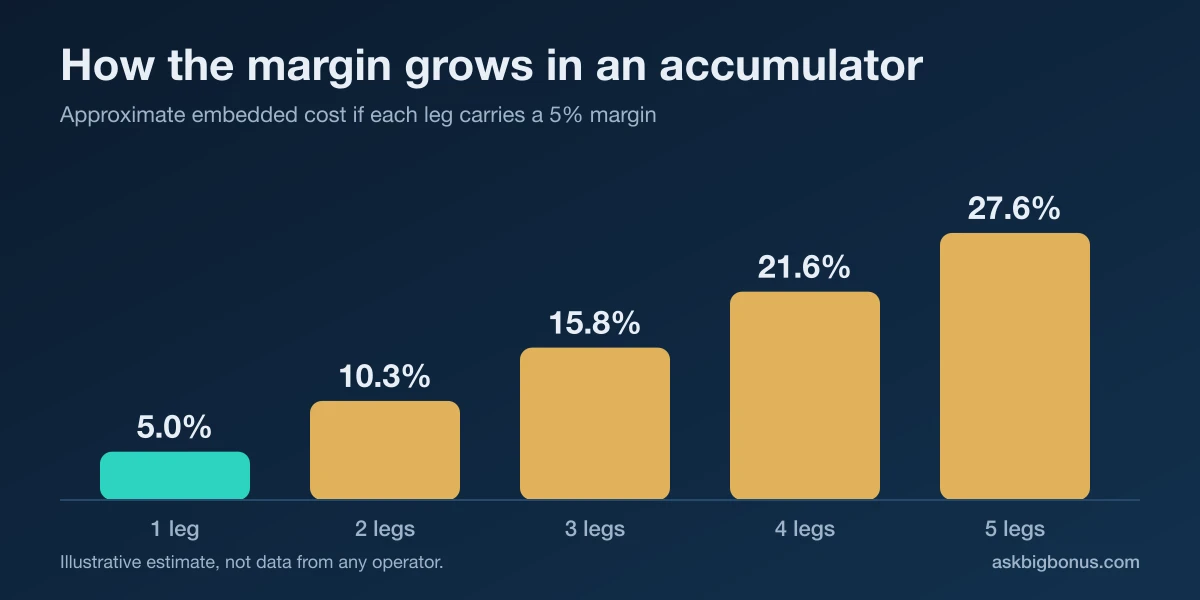
The less obvious point is that the margin multiplies too. If each selection carries a margin of roughly 5%, the three-leg combination carries around 1.05 × 1.05 × 1.05 = 1.158, an embedded cost of about 15.8% compared with 5% on a single bet. The more legs, the higher the cost. That is why accumulators are so popular with operators: the possible payout is high and so is the accumulated margin.
This does not make accumulators forbidden or "wrong". It means anyone who uses them should know they are paying more for each unit of risk.
Common mistakes when reading odds
- Treating short odds as a safe bet. Odds of 1.20 imply about an 83% chance. The remaining 17% exist and, because the profit is small, one loss wipes out many wins.
- Looking only at the payout. Long odds are long because the outcome is unlikely. The big payout compensates for the low chance, not the other way round.
- Ignoring the margin. Two markets that look alike can cost very different amounts. Compare before you decide.
- Thinking odds predict the result. They reflect prices and money wagered. They are not a guarantee about the match.
- Chasing losses by raising the stake. The odds do not "owe" you anything. Each event is independent.
- Not checking the odds at confirmation. They can change between the click and the confirmation.
Responsible gambling and legal context
Understanding odds helps you make better-informed decisions, but it does not make betting profitable. The bookmaker margin means that, on average, people who bet lose money, and no knowledge removes that risk. Only stake money you can afford to lose without harming your finances, set limits before you start and take breaks. If betting is causing problems, seek professional help and talk to people you trust. Betting is for adults aged 18 and over.
Mind the legal context. The rules on fixed-odds betting in Brazil changed during 2026 and may change again. This guide is educational only, recommends no service and is not legal advice. For the current position, read our guide to MP 1.394/2026 and consult the official sources.
Frequently asked questions
Which odds format is used in Brazil?
Operators serving Brazilian players usually show decimal odds such as 1.85 or 2.40. Some let you switch to fractional or American in your account settings.
How do I work out the probability from odds?
Divide 1 by the decimal odds. Odds of 2.50 equal 1 ÷ 2.50 = 40%. Remember that this figure already includes the bookmaker margin.
What is the bookmaker margin, or overround?
It is the gap between the sum of a market's implied probabilities and 100%. It represents the built-in cost of the market to the bettor.
Are short odds always safer?
They signal that the outcome is more likely, but they are not safe. The profit per win is small and a single loss can erase several wins.
What is a value bet?
A bet where the true probability of the outcome is higher than the probability implied by the odds. It depends on your estimate, which may be wrong.
Why do accumulators cost more?
Because the odds and the margins of each selection are multiplied. The more legs, the higher the embedded cost and the lower the chance of landing everything.
Summary to keep
- Return = stake × decimal odds; profit = return − stake.
- Implied probability = 1 ÷ odds. Odds of 2.00 need a win rate above 50% to break even.
- A market's probabilities add up to more than 100%: the surplus is the bookmaker margin.
- To compare operators, normalise the probabilities by dividing by their sum.
- Expected value = (estimated probability × odds) − 1, and the estimate is the weak point.
- Accumulators compound the margin. No technique removes the risk of losing.
Written by
iGaming Journalist & Editorial Specialist
Jamie Reyes is an iGaming journalist and editorial specialist with eight years of experience covering online betting and casino markets. Jamie focuses on operator licensing, payment systems, regulatory developments, player-facing terms and the factors that determine whether an online gambling platform is genuinely trustworthy. As AskBigBonus's editorial lead covering licensing and payments, Jamie is responsible for how the site researches and presents that information — checking regulatory status, payment availability, withdrawal processes and the terms attached to bonuses, then turning that research into content a player can actually use before signing up. That work feeds directly into how AskBigBonus evaluates operators across the site.
Expertise: Online Betting Sites, Online Casinos, Gambling Licenses, Operator Regulation, Payment Methods, Deposits & Withdrawals, KYC & Verification, Responsible Gambling, Betting Terms & Conditions, Trust & Safety, Sports Betting Markets, iGaming Industry News